
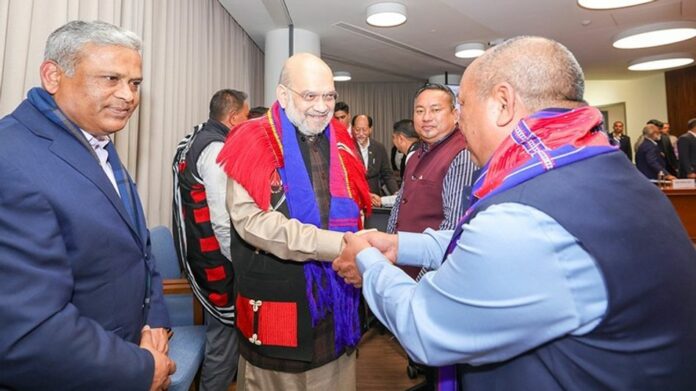
Kohima, Feb 11: The Working Committee of the Naga National Political Groups (WC-NNPG) on February 10 welcomed the tripartite agreement signed on February 5, establishing the Frontier Nagaland Territorial Authority (FNTA) for eastern Nagaland, while cautioning that the development must be understood within the broader context of the unresolved Indo–Naga political issue.
In a press statement, the WC-NNPG described the agreement between the Government of India, the Eastern Nagaland Peoples’ Organisation (ENPO), and the Nagaland government as a “timely correction of the historical injustice” faced by eastern Nagaland, adding that it “rekindles hope” in the region and underscores that the will of the people is supreme. The committee emphasised that the new arrangement should address long-standing administrative and economic gaps, urging eastern Nagas to establish an “ingenious, independent and transparent mechanism” to ensure that commitments translate into tangible progress on the ground.
While welcoming the FNTA initiative, the WC-NNPG stressed that the larger Indo–Naga political issue, covering the entire Naga ancestral homeland, remains unresolved. The committee recalled that formal negotiations concluded on October 31, 2019, and that “clear negotiated charters” are currently before Prime Minister Narendra Modi and Union Home Minister Amit Shah. The statement noted that the “Status Paper” includes Nagas in Nagaland, Manipur, Assam, and Arunachal Pradesh, and affirmed that both New Delhi and Kohima remain aligned on the process. It added, however, that any separate agenda pursued by the Nagaland government or the appointment of a new interlocutor would constitute a distinct matter.
Reiterating its role as a negotiating entity, the WC-NNPG declared that the Indo–Naga talks have concluded and that all core political issues have been thoroughly deliberated. It described any attempt to downgrade the “Agreed Position” as “inconceivable” and underlined that the only practical way forward is the announcement and signing of a final political agreement in line with the negotiated terms, which it said is essential for lasting peace and coexistence.
