
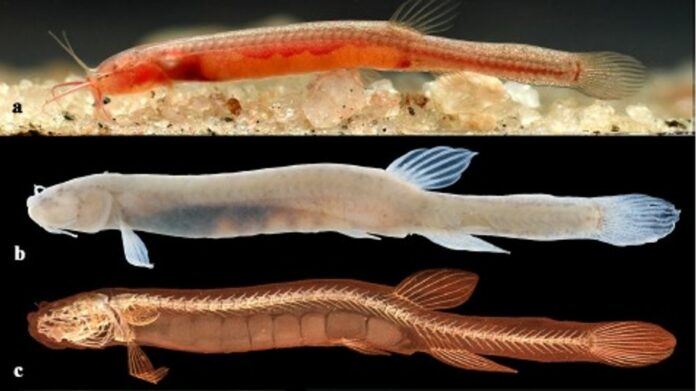
Guwahati, Feb 28: In a major scientific breakthrough, researchers have identified a new genus and species of subterranean fish, Gitchak nakana, from a dug-out well in Assam, marking the first aquifer-dwelling (phreatobitic) fish recorded from Northeast India. The findings have been published in Scientific Reports.
The study was led by Ralf Britz of the Senckenberg Naturhistorische Sammlungen Dresden, in collaboration with scientists including Wimarithy K. Marak of Assam Don Bosco University and other national and international institutions.
The newly described species is a miniature, blind and pigmentless cobitid loach displaying pronounced troglomorphic traits typically associated with subterranean life, including the absence of eyes and loss of pigmentation. Specimens were collected on three separate occasions from the same well in a village at the foothills of the Shillong Plateau near the Brahmaputra River valley in western Assam.
One of the fish’s most striking anatomical features is the complete absence of a skull roof, with the brain covered only by skin on the dorsal side — a characteristic not documented in other known cobitid genera. Owing to these distinct morphological traits, researchers classified it as both a new genus and a new species.
Globally, more than 300 fish species are known to inhabit subterranean environments, but most are cave dwellers. Fewer than 10 per cent are known from groundwater aquifers, making such discoveries particularly rare. While the Shillong Plateau is recognised for cave-dwelling fishes such as species of the genus Schistura and the large subterranean fish Neolissochilus pnar, Gitchak nakana is the first aquifer-dwelling fish reported from the region and the first subterranean cobitid documented in Northeast India.
The discovery broadens scientific knowledge of subterranean biodiversity in the region and suggests the existence of previously undocumented underground fauna in this part of Asia. Researchers have also detailed the species’ unusual skeletal structure and proposed hypotheses about its evolutionary placement among cobitid loaches.
The study highlights the ecological importance of groundwater habitats and calls attention to the need for further exploration and conservation of fragile subterranean ecosystems in Northeast India.
