
Guwahati, March 17: Researchers at Indian Institute of Technology Guwahati have developed an advanced material capable of producing hydrogen fuel through water electrolysis while also enabling solar-powered desalination, offering a potential solution to the dual global challenges of clean energy and safe drinking water.
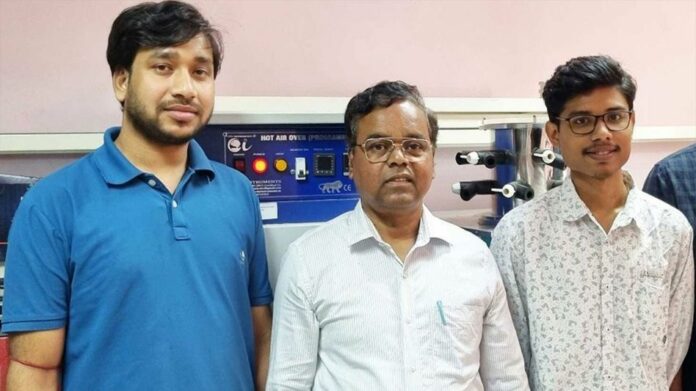
The study, published in Advanced Functional Materials, was led by P K Giri from the Department of Physics, along with research scholars Koushik Ghosh and Sanjoy Sur Roy.
Hydrogen is considered a clean fuel as it produces only water upon use and does not emit carbon. However, most hydrogen production currently depends on fossil fuels, making sustainable alternatives a priority. At the same time, desalination remains costly, limiting access to potable water in many regions.
Addressing both challenges, the research team developed an MXene-based catalyst capable of efficiently generating hydrogen while supporting desalination using solar energy. MXenes, known for their high electrical conductivity, often face limitations due to reduced active surface area. To overcome this, the researchers engineered ultra-thin, ribbon-like structures that enhance charge transport and increase active catalytic sites. The introduction of ruthenium atoms into oxygen-deficient regions further improved performance.
Experimental findings showed that the material achieved an ultralow hydrogen evolution reaction overpotential of 12 mV, outperforming conventional platinum-based Pt/C electrodes. The catalyst also demonstrated long-term stability with minimal degradation. Computational modelling was used to analyse how atomic-level modifications contributed to improved efficiency, while simulated sunlight tests confirmed enhanced performance through strong photothermal conversion.
For desalination, the material was integrated into a three-dimensional “Janus evaporator” designed to float on water and concentrate heat at the surface, reducing energy loss. Under standard sunlight conditions, the system achieved an evaporation rate of approximately 3.2 kilograms per square metre per hour and operated continuously in saline water for five days without salt accumulation.
Tests further confirmed that the system effectively removed salts and contaminants, producing water that meets international drinking standards.
Commenting on the development, Prof Giri described MXene as a versatile material with wide-ranging applications. He noted that the study demonstrates a sustainable pathway for clean hydrogen production and drinking water solutions through advanced material engineering, with strong potential for future commercial deployment.
The research highlights the possibility of using a single material system for both renewable energy generation and water purification, with potential applications in transport, industry and energy storage.
