
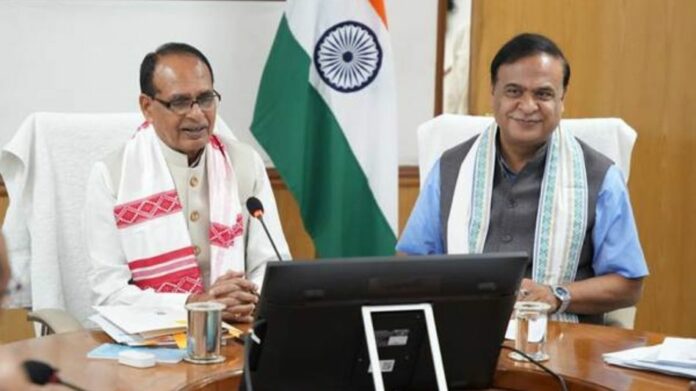
Guwahati, June 3: Union Agriculture and Rural Development Minister Shivraj Singh Chouhan assured the Assam government of complete financial and institutional support for strengthening the state’s agriculture sector and rural development programmes, emphasising that there would be no shortage of funds for key initiatives.
The assurance came during a meeting with Assam Chief Minister Himanta Biswa Sarma in New Delhi, where both leaders reviewed the implementation of centrally sponsored schemes and discussed strategies to accelerate agricultural growth and rural infrastructure development across the state.
According to an official statement, the discussions focused on evaluating the progress of projects under the Agriculture and Rural Development departments and exploring avenues for deeper collaboration between the Centre and the Assam government. Chouhan reaffirmed the Centre’s commitment to Assam’s development and stressed the importance of maximising the benefits of flagship programmes such as the Agriculture Infrastructure Fund (AIF), Pradhan Mantri Awas Yojana-Gramin (PMAY-G), Mahatma Gandhi National Rural Employment Guarantee Act (MGNREGA) and other welfare schemes.
During the meeting, Rural Development Secretary Rohit Kansal informed the Chief Minister that technical issues affecting the implementation of PMAY-G and MGNREGA in Assam had been resolved. He also stated that MGNREGA funds had been allocated in line with the state’s requirements. Kansal further revealed that the proposed Vikas Bharat-Rozgar Evam Aajeevika Mission (Rural) is expected to replace MGNREGA nationwide from July 1 as part of efforts to strengthen rural employment and livelihood generation.
A key outcome of the meeting was the presentation of a draft Agriculture Action Plan tailored to Assam’s agro-climatic conditions and soil profile. Chouhan handed over the plan to Sarma, describing it as a roadmap for improving productivity, encouraging crop diversification and promoting sustainable agricultural growth in the state.
Officials also highlighted Assam’s achievements under the Lakhpati Didi programme, noting that the state has already created more than nine lakh women entrepreneurs, surpassing its assigned target. To further expand women-led economic activities, the Centre and the state government will collaborate with incubation centres at Assam Agricultural University to provide training, business support and market access.
The meeting reviewed projects under the Agricultural Mechanisation Programme and the Rashtriya Krishi Vikas Yojana (RKVY), aimed at modernising farming practices and increasing agricultural output. Agriculture Secretary Atish Chandra informed the Chief Minister that efforts are underway to distribute power weeders to women farmers to reduce labour-intensive work and improve farm productivity.
Expansion of the National Mission on Edible Oils-Oil Palm (NMEO-OP) in Assam also featured in the discussions, with both sides exploring ways to increase edible oil production and diversify farmers’ income sources. To encourage protected cultivation, the Centre has approved 1,500 bamboo polyhouses for the state during the current year, a move expected to support year-round farming and enhance crop yields.
The Centre has additionally approved infrastructure for a Pesticide Testing Laboratory and an Edible Oil Testing Laboratory under RKVY to strengthen quality control measures and improve food safety standards. Efforts are also underway to establish partnerships with the Agricultural and Processed Food Products Export Development Authority (APEDA) and the National Organic Cooperative Limited to expand export opportunities for Assam’s organic produce.
Meanwhile, Narendra Bhushan, Secretary of the Department of Land Resources, informed the meeting that the digitisation of land records in Assam is progressing steadily. The initiative is expected to improve transparency, streamline land administration and enhance public service delivery.
The meeting underscored the Centre’s continued focus on boosting Assam’s agricultural economy through infrastructure development, technological support, rural livelihood generation and enhanced market access, with both governments committing to closer coordination for sustainable growth.
