
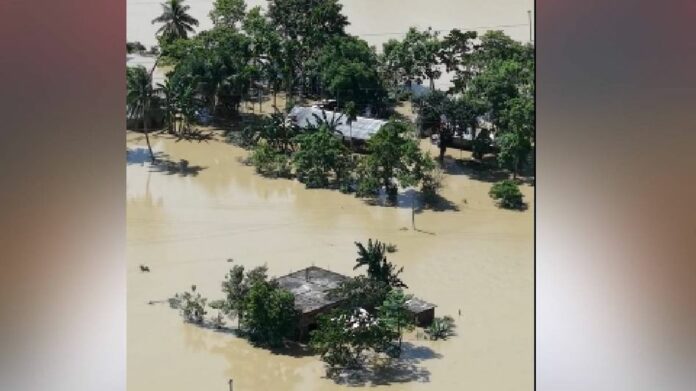
Assam is facing one of its worst flood disasters in recent years, with more than nine lakh people across over 1,800 villages in 25 districts affected and the death toll rising to 41. The floods have also resulted in the loss of thousands of livestock, adding to the humanitarian and economic challenges confronting the state.
According to the Assam government, the crisis has been caused by a combination of upstream cloudbursts and exceptionally heavy localised rainfall, with precipitation recorded at 436 per cent above normal. Officials said the unprecedented rainfall has inundated several villages that had not experienced flooding of such severity in recent decades.
The state government has launched an extensive multi-agency response, coordinating rescue, evacuation and relief operations with the Indian Air Force, the National Disaster Response Force (NDRF), the State Disaster Response Force (SDRF), district administrations and other departments. Helicopters and boats are being deployed to rescue stranded residents in the worst-affected areas as operations continue round the clock.
To accommodate displaced families, more than 148 relief camps have been set up across the state, providing shelter to nearly 30,000 people. Relief teams are also distributing food, drinking water and other essential supplies to affected communities.
Officials said over 3,00,000 kilograms of rice and other relief materials have already been dispatched to the worst-hit districts, with additional supplies being sent as the relief effort expands.
Alongside emergency measures, the government said it is working with various departments and the Centre to formulate a comprehensive long-term rehabilitation package to help affected families rebuild their lives once the floodwaters recede.
The state also plans to initiate discussions with neighbouring states after the immediate crisis subsides to strengthen inter-state coordination on disaster preparedness, particularly to address the impact of upstream cloudbursts and other hydrological events that contribute to severe flooding.
