
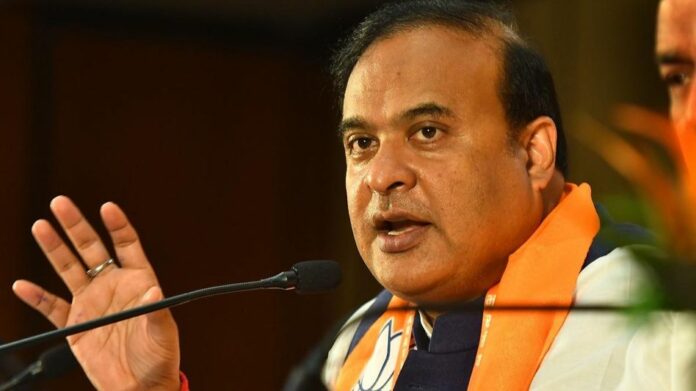
Assam Chief Minister Himanta Biswa Sarma on Tuesday said a significant number of people living in the flood-hit districts of Sivasagar and Charaideo depended on coal and stone mining activities in neighbouring Nagaland for their livelihood, and urged local residents to decide whether such operations should continue.
The Chief Minister’s remarks came against the backdrop of mounting demands from opposition parties and social organisations to halt alleged illegal coal and stone mining along the Assam-Nagaland border. These groups have claimed that the mining activities were responsible for the devastating floods that recently ravaged parts of Upper Assam.
After inspecting several flood-affected areas, Sarma said the Assam government had no authority to stop mining activities taking place inside Nagaland and that any discussion on the issue would have to be taken up with the neighbouring state through the Central government. He said the livelihoods of many people in the affected areas were linked to the mining sector and appealed to the public to consider the implications before taking a stand.
The Chief Minister pointed out that stones used in the affected areas were sourced from Nagaland, where mining was carried out, and reiterated that Assam could not interfere in another state’s mining policies. He added that while the Assam government could act against stone crushers operating within its jurisdiction, it could not impose restrictions on mining activities in Nagaland.
Sarma said the state government would seek discussions with Nagaland through the Centre once the immediate flood situation improved. He maintained that there was no illegal mining taking place within Assam and said he would personally pursue the matter after the relief operations eased.
He also refrained from directly attributing the scale of the floods to mining activities, stressing that a scientific investigation was necessary before drawing conclusions. According to Sarma, the nature of this year’s floods differed from previous years despite annual rainfall, and institutions such as the Indian Institutes of Technology would need to analyse satellite data to determine the actual causes.
The opposition Congress, Raijor Dal, Assam Jatiya Parishad and the Krishak Mukti Sangram Samiti have alleged that the floods in Upper Assam were “man-made”, claiming they resulted from an alleged nexus involving coal and stone mining interests and influential political figures in Assam and Nagaland. They have further alleged that open-cast mining in the hilly areas along the inter-state border created pits and artificial reservoirs, which overflowed during heavy rainfall and contributed to flash floods in downstream areas of Assam.
The latest floods caused extensive damage across Sivasagar and Charaideo, particularly in villages along the Assam-Nagaland border. The death toll rose to 89, while more than 1.22 lakh people remained affected even as floodwaters receded from several parts of the state.
During his visit, Sarma inspected a relief camp at the Rajiv Gandhi Institute of Petroleum Technology campus in Sivasagar and interacted with displaced families. He assured flood victims that the government would continue supporting them through rehabilitation and recovery measures and said officials were gathering feedback to ensure affected families had received relief and assistance.
The Chief Minister announced that government teams would begin visiting flood-affected households from August 9 to conduct detailed damage assessments. He said compensation would be released after the completion of the survey and assured residents that the government would provide all possible assistance to restore normalcy.
According to a statement issued by the Chief Minister’s Office, Sarma instructed the district administration to ensure uninterrupted supply of food, safe drinking water, healthcare services and essential facilities for children, women and elderly people staying in relief camps.
As part of the relief measures, the Chief Minister handed over cheques of Rs 5 lakh each from the Chief Minister’s Relief Fund to the next of kin of 10 people who lost their lives in the floods. The families had earlier received Rs 4 lakh each under the State Disaster Response Fund, taking the total ex gratia assistance to Rs 9 lakh per deceased person.
Sarma also announced that Union Health Minister J. P. Nadda would visit Upper Assam on Wednesday to review the flood situation and interact with affected residents.
During the day, the Chief Minister toured several flood-affected locations, including Rajabari, Dihirgaon, Dhai Ali-Darikhat, Kakpathar-Kukurpuhia and Banmukh, where he assessed the damage and met local residents. Travelling by rubber boat, he also visited the marooned villages of Panbecha, Hatimuria, Betena, Dhupaboria, Tatipathar and Luruki to review the situation firsthand and understand the challenges faced by the affected communities.
