
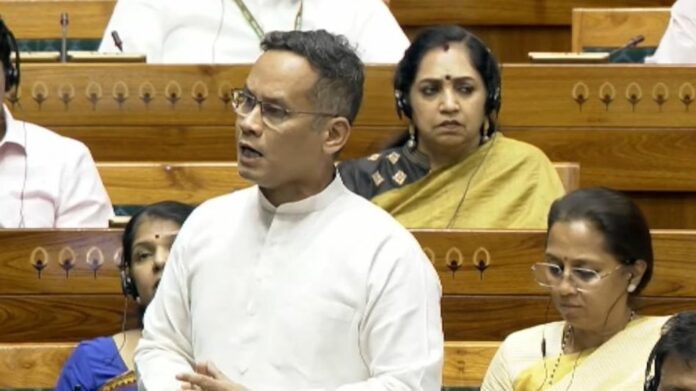
Congress MP Gaurav Gogoi has questioned the effectiveness of Assam’s flood warning and disaster response mechanism after the Centre informed Parliament that the Indian Space Research Organisation (ISRO) provides near real-time flood monitoring for the Brahmaputra basin, with flood inundation maps reaching the Assam State Disaster Management Authority (ASDMA) within five to six hours of satellite data acquisition.
In a written reply to an unstarred question raised by Gogoi in the Lok Sabha on August 5, the Department of Space stated that ISRO disseminates satellite-based flood inundation maps and value-added products to disaster management authorities within five to six hours of receiving satellite data.
The Centre informed Parliament that ISRO has been providing Near Real-Time (NRT) satellite-based flood monitoring for the Brahmaputra basin. During the 2025 monsoon season, 45 flood inundation maps and related products were shared with ASDMA, while 33 such products had been supplied during the 2026 monsoon season up to July 28.
According to the reply, the flood maps are generated using data from EOS-04 (RISAT-1A), Resourcesat-2/2A, Cartosat-2E and Cartosat-3 satellites. The information is disseminated through the National Database for Emergency Management (NDEM), the Bhuvan platform and directly to the Assam State Disaster Management Authority.
The Centre also said ISRO has introduced several initiatives to improve the timeliness and district-level accuracy of flood information, including semi-automated flood-mapping workflows, district-level flood reports and the use of high-resolution satellite imagery for damage assessment, subject to the availability of cloud-free satellite data.
Responding to the government’s reply, Gogoi questioned why the availability of near real-time flood monitoring did not lead to timely warnings for districts affected by the flash floods.
In a post on X, the Congress MP said the Centre had confirmed that ISRO provides near real-time flood monitoring for the Brahmaputra basin and that flood data reaches ASDMA within five to six hours. However, he noted that the Sivasagar District Commissioner had stated the district had barely three hours to respond to the flash floods of July 19 and had received no prior warning.
Gogoi said the government must explain why the available flood monitoring data did not translate into timely alerts and preparedness on the ground. His remarks refer to the devastating flash floods that struck parts of Upper Assam on July 19, causing extensive damage in Sivasagar, Jorhat, Golaghat and Charaideo districts.
