
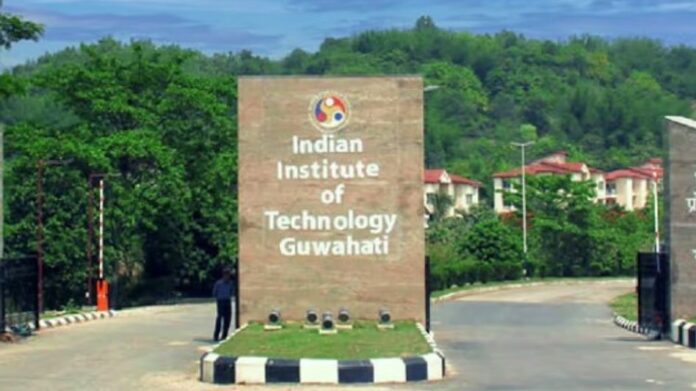
Guwahati, August 14: Researchers at the Indian Institute of Technology-Guwahati have developed a low-cost catalyst for producing hydrogen from water, a breakthrough that could support India’s National Green Hydrogen Mission and the transition towards cleaner energy.
Hydrogen is considered an important clean-energy source because its use for power generation produces water as the only byproduct. It is also widely used in fuel cells and industries such as fertiliser manufacturing. However, about 90-95 per cent of hydrogen is currently produced from fossil fuels, resulting in greenhouse gas emissions.
Water electrolysis offers a cleaner method of hydrogen production but depends on efficient catalysts. Many high-performance catalysts use rare and expensive noble metals, limiting their large-scale application.
To address this, the IIT-Guwahati team used inexpensive nickel salt combined with an anthracene-based organic molecule to develop a coordination polymer-based catalyst. The material was synthesised at room temperature through a simple ultrasonic process, said Akshai Kumar, associate professor in the institute’s Department of Chemistry, who led the study.
According to Kumar, the catalyst’s structure provides a high density of active sites for the hydrogen evolution reaction while facilitating efficient electron transport. The researchers found that the material remained stable during long-term operation and utilised nearly 88 per cent of the supplied electrical energy for water splitting.
Kalishankar Bhattacharyya, assistant professor in the Department of Chemistry, said the study demonstrated a synergistic effect between nickel and the anthracene-based framework, with both components contributing to the catalyst’s performance.
Chemical analysis and modelling showed that nickel atoms formed a three-dimensional network with the anthracene component, helping explain the material’s efficiency.
The findings have been published in the Journal of Materials Chemistry A. The study was co-authored by Kumar and Bhattacharyya, along with research scholars Niharika Tanwar, Jumana Ishrat and Khadimul Islam.
