
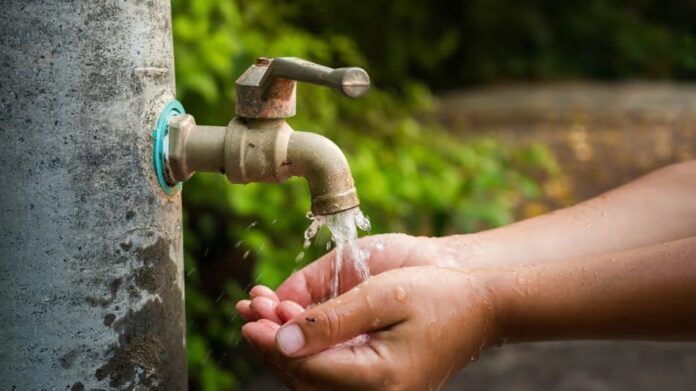
SHILLONG, Sept 16: Meghalaya has shifted the focus of Jal Jeevan Mission (JJM) 2.0 from expanding household tap connections to ensuring that existing schemes provide regular, adequate and safe drinking water.
The Public Health Engineering (PHE) Department said 5,47,869 rural households, or 84 per cent of the state’s 6,50,854 rural households, had received tap-water connections as of September 6, 2026. Coverage has risen sharply from 4,550 households, or 1 per cent, in August 2019.
The next phase will assess whether completed infrastructure is actually delivering water to households. Ground-level assessments are being conducted to identify gaps in tap availability, regularity and adequacy of supply, with corrective measures planned where necessary.
Meghalaya currently has 7,795 JJM schemes, of which 6,195 have been physically completed. The department is strengthening arrangements for schemes entering the operation and maintenance phase and is developing a policy framework for maintaining water-supply assets after completion. Digital systems are also being used to consolidate scheme, asset and financial data for better monitoring and field-level problem resolution.
Water-source sustainability is another priority under JJM 2.0. The state has identified 785 critical water sources for rejuvenation and mapped around 55,000 springs and 70,000 spring sheds. It is also working on a Payment for Ecosystem Services model to encourage communities to protect water sources and forest ecosystems.
Under the Meg ARISE initiative, catchments in 180 villages are being restored to strengthen climate-resilient water sources. The department said the measures were aimed at securing household water supply while protecting the natural sources on which rural water systems depend.
The state is also expanding water-quality monitoring. As many as 31,829 women across villages have been trained to conduct water-quality tests using Field Test Kits, alongside laboratory and field-level testing.
JJM 2.0 is thus placing greater emphasis on the quality, reliability and long-term sustainability of rural water services rather than only the number of household connections created.
