
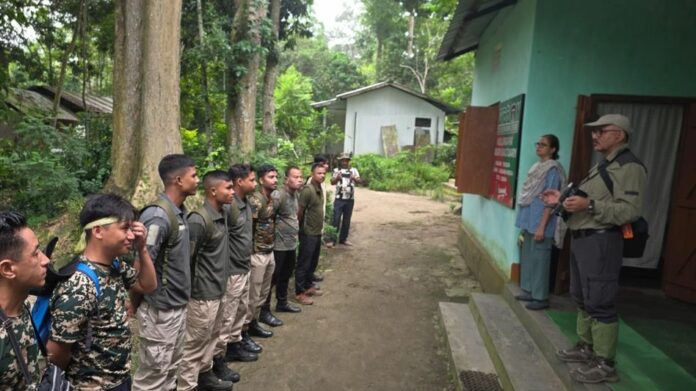
MARIANI, Sept 27: A week-long residential training programme aimed at strengthening the capacity of frontline forest personnel in Western Hoolock Gibbon conservation concluded on September 25 at the Gibbon Conservation Centre of Aaranyak within Hollongapar Gibbon Sanctuary in Assam’s Golaghat district.
The first batch, held from September 19 to 25, brought together 15 Forest Guards from the Forest Departments of Assam, Meghalaya and Nagaland. It was the first dedicated training programme on Hoolock gibbon conservation to bring frontline forest personnel from the three northeastern states together.
Aaranyak organised the programme in collaboration with the Jorhat Forest Division of the Assam Forest Department, with support from The Habitats Trust and the IUCN Primate Specialists Group.
The training focused on strengthening field-level knowledge and practical skills for the long-term conservation of the Western Hoolock Gibbon (Hoolock hoolock) and its fragmented habitat. Sessions covered biodiversity and primate conservation, gibbon census and population estimation, field data collection, floristic studies, habitat restoration and monitoring, wildlife rescue and rehabilitation, GPS use and wildlife laws.
As part of the practical training, participants conducted field observations across five tracks over five days, gaining experience in field research and conservation techniques.
The programme was inaugurated on September 19 by Dr Dilip Chetry, Director and Head of Aaranyak’s Primate Research and Conservation Division and Vice Chair of the IUCN Primate Specialist Group South Asia. Training sessions and field exercises were led by experts from Assam Agricultural University, USTM and Aaranyak, along with a former Deputy Conservator of Forest.
At the concluding session, participants were urged to apply their learning through practical conservation action. Dr Chetry thanked the forest departments of the three states for deputing personnel and acknowledged the support of the Jorhat Forest Division and the local community.
The programme concluded with the distribution of training manuals, Hoolock gibbon conservation books, posters and certificates to the participants.
