
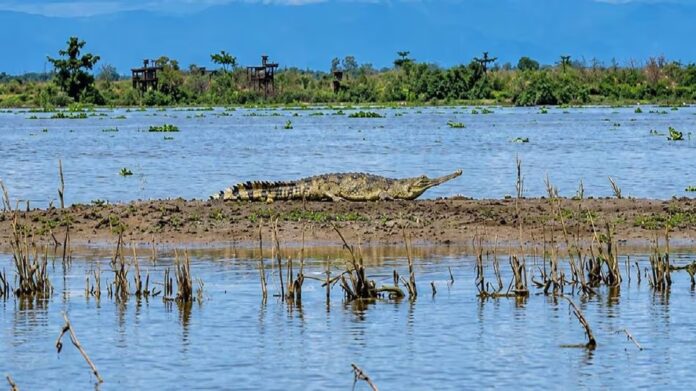
TINSUKIA, Oct 6: A critically endangered gharial has been spotted at the confluence of the Lohit and Brahmaputra rivers in Assam’s Tinsukia district, providing a rare recent record of the species from the Lohit River and highlighting the need for systematic monitoring of gharial populations in the Brahmaputra basin.
The gharial (Gavialis gangeticus), listed as a Schedule I species under the Wildlife (Protection) Act, 1972, was photographed basking on a sandbank at the Lohit-Brahmaputra confluence on September 25 during a biodiversity survey.
The survey was jointly conducted by the Seed to Forest Foundation, the Balipara Foundation team and members of the local community. It was led by Manas Pratim Sharma and Sandip Chetri. The sighting took place outside a protected area, close to the broader Dibru-Saikhowa-Brahmaputra river landscape.
Gautam Baruah, Chief Operating Architect of the Balipara Foundation, said the organisation had been carrying out biodiversity assessments and monitoring outside protected areas in partnership with local communities.
He said the sighting demonstrated the potential of community-based monitoring to document rare and threatened riverine species.
Manas Pratim Sharma, founding member of the Seed to Forest Foundation, said the record underlined the need for systematic surveys to assess the status and distribution of gharials across the Lohit and Brahmaputra river systems.
The gharial is a semi-aquatic freshwater crocodilian distinguished by its long, slender snout. It historically occurred across several major river systems of the Indian subcontinent, including the Brahmaputra basin.
Its population has declined significantly because of changes in land use and land cover, dam construction, sand mining, poaching, egg collection and disturbance at nesting sites. Major surviving populations are now concentrated in a limited number of river systems, particularly the Ganga basin.
A 2026 Wildlife Institute of India study of the Gangetic river basin reported a population of 3,037 gharials.
In Assam, gharials were historically reported from the Brahmaputra and Barak river systems, although recent records from the Brahmaputra basin remain limited.
A gharial was sighted upstream near Dibru-Saikhowa National Park in November 2022, while another was recorded in the lower-middle stretch of the Brahmaputra at Kaziranga National Park in May 2026. No recent sighting has been reported from the Barak river system.
The latest record at the Lohit-Brahmaputra confluence, along with previous sightings, points to the need for further surveys to determine the current distribution, population status and habitat conditions of gharials in Assam’s Lohit-Brahmaputra river landscape.
