
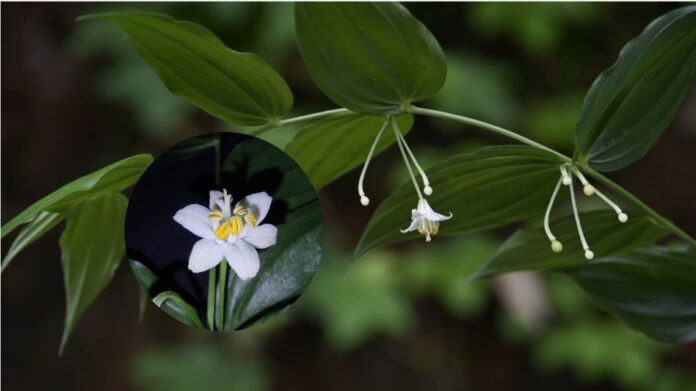
A new species of flowering plant has been discovered in the forests of Assam and Meghalaya, adding to Northeast India’s biodiversity. Named Disporum kamakhasiense, the species has been formally documented in the international botanical journal Novon.
The perennial herb belongs to the Colchicaceae family and has been recorded at three locations: Garbhanga Reserve Forest in Assam, Laisong in Dima Hasao district and the Barapani area of Meghalaya.
The research, authored by Dixit Bora, Biswajit Paul, Devanjal Bora, Aaron Floden and Dipankar Borah, establishes the plant as a distinct species with several characteristics that differentiate it from related varieties.
Growing up to 180 cm, it is considerably taller than its closest relative, Disporum calcaratum, which generally reaches around 100 cm. The plant has branched stems, broad yellowish-green leaves with prominent veins and white, star-shaped flowers.
Its scientific name combines references to Kamrupa, the ancient name for Assam, and the Khasi Hills of Meghalaya, reflecting the regions where it was first collected.
The species grows on cliffs, mainly beneath bamboo forests, at elevations between 200 and 1,100 metres. Researchers distinguished it from similar plants found in Thailand and Myanmar through its larger size, smooth leaves and differences in floral structure.
However, the researchers have flagged concerns over its survival, as only a few small populations with limited individual plants have been recorded so far.
The study describes the species as “potentially endangered”, identifying road expansion, over-exploitation and deforestation as major threats to its habitat. The authors have called for further studies to determine its conservation status, warning that its restricted distribution could put its long-term survival at risk.
