
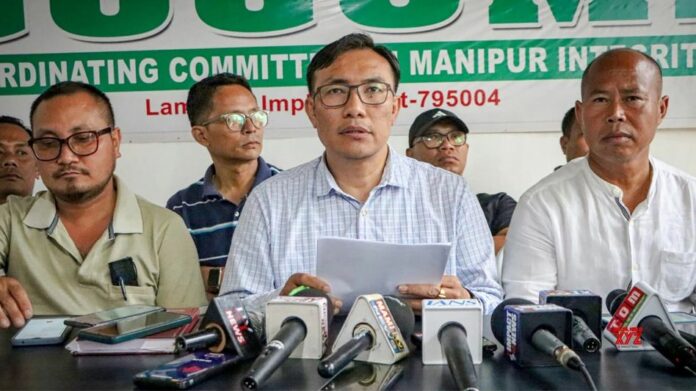
The Coordinating Committee on Manipur Integrity (COCOMI) submitted a detailed memorandum to the Prime Minister countering recent claims by the United People’s Front (UPF) and the Kuki National Organisation (KNO) over historical jurisdiction and ancestral land rights in Manipur’s hill areas.
The memorandum followed the UPF–KNO meeting with Home Ministry officials in New Delhi on 6 and 7 November, during which the groups reportedly asserted that the hill areas of Manipur were never under the authority of the Maharaja. COCOMI described this claim as “misleading” and said historical records, colonial documents and judicial rulings presented a different account.
COCOMI argued that references such as the Manipur State Darbar Rules of 1907 showed that both the valley and the hills were administered under the Manipur State. It also cited legal continuity after Independence, pointing to court judgments from 1963 and 1979 that recognised the State’s authority over forests and land in the hills.
The memorandum challenged the Kuki groups’ assertion of ancestral ownership, describing Kuki settlement in Manipur as a “colonial-era development” facilitated by British officials between the mid-19th and early 20th centuries. It referred to records of British Political Agent William McCulloch, who documented the settlement of Kuki villages as part of the colonial frontier strategy.
COCOMI further stated that the term “Kuki” emerged during the colonial period as an administrative classification rather than an indigenous identity, arguing that this weakened claims to indigeneity.
The organisation maintained that customary land and forest rights exercised by tribal communities were historically usufructuary—intended for livelihood rather than ownership—under the legal framework of the time.
Concluding the memorandum, COCOMI urged the Centre to dismiss what it called “ahistorical claims,” warning that their acceptance would undermine Manipur’s territorial integrity.
The memorandum was signed by COCOMI convenor Khuraijam Athouba.
