
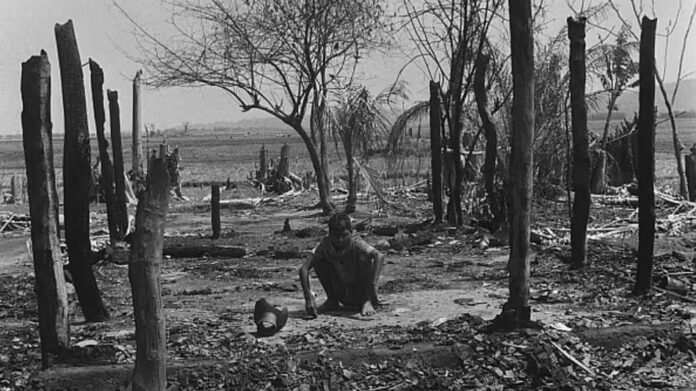
A group of prominent citizens has issued a strong appeal to the Assam government, urging it to refrain from utilizing the long-suppressed Tewary Commission Report on the 1983 Nellie massacre as a political tool. They cautioned that any selective application of the report’s findings could exacerbate existing tensions related to illegal migration instead of providing a resolution to the longstanding concerns. This plea was made during a public discussion organized by a digital platform that recently obtained the confidential report through the Right to Information Act (RTI). While the Assam Cabinet has resolved to distribute copies of the report within the Assembly during the upcoming session, Chief Minister Himanta Biswa Sarma has clarified that the legislative body will not be debating its contents.
The speakers at the event underscored the report’s significant historical value, noting its documentation of 8,019 incidents of violence across the state in 1983. These events led to a tragic loss of 2,072 lives, the displacement of over 2.26 lakh people, and more than 2.48 lakh individuals seeking shelter in relief camps. They emphasized that given these stark facts, the findings must be approached with the utmost responsibility. Jyoti Prasad Rajkhowa, former Arunachal Pradesh Governor and former Assam chief secretary, raised questions about the inquiry’s structure, asserting that a judicial commission should have been appointed instead of assigning the probe to “a chief secretary-level officer from outside the state,” which he noted “remains a question even today.” Rajkhowa also highlighted the report’s failure to clarify how such widespread violence erupted while the state was under President’s rule, suggesting that publishing the findings four decades earlier might have enabled “some resolution of the problems.”
Senior advocate Santanu Barthakur stressed that the underlying “background to the Tewary Commission is immigration” and warned that discussing isolated sections of the document could provoke “a seriously adverse reaction.” He argued that the government’s primary focus should be on addressing public anxieties surrounding illegal migration and ensuring the swift implementation of pending safeguards for the indigenous communities as mandated under Clause 6 of the Assam Accord. Bedabrata Lahkar, a veteran journalist who covered the Nellie massacre, recalled that in 1983, “the entire administrative machinery was preoccupied with conducting the elections.” He supported the report’s observation that the violence did not possess “any specific communal character,” with causes varying across different districts, adding that “Nobody really knew where and why violence was erupting.” The collective consensus among the speakers was that the issues which fueled the Assam Agitation remain unresolved. They concluded that the Tewary Commission Report, resurfacing after almost 40 years, should be utilized to inform policy decisions and alleviate public concerns, rather than being leveraged to incite political confrontation.
