
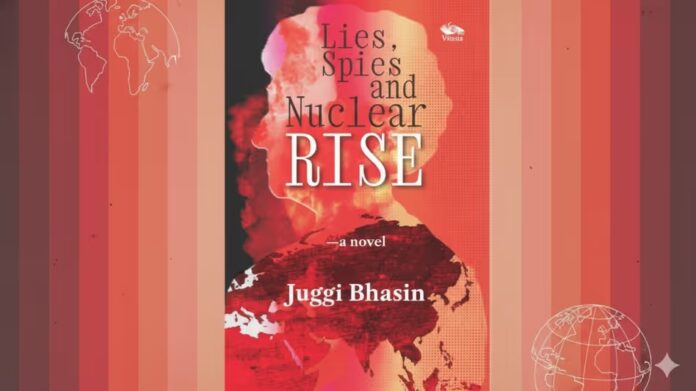
Juggi Bhasin’s latest novel, ‘Lies, Spies and Nuclear Rise’, centers on a fictional and formidable Prime Minister of India, Priya Kaul, who is introduced to the world via screaming headlines that announce, “‘Goddess incarnate Priya Kaul conducts India’s first nuclear test in a desert’.” This dramatic, seemingly spiritual opening quickly pivots to the realities of a political thriller as the narrative escalates the peril surrounding the PM with the looming threat of an assassination. The decision to cast a fictional woman as India’s premier might divide readers—some may find a fictional Priya Kaul an immediate barrier, while others might welcome the fresh and bold characterisation.
Bhasin constructs this parallel universe around a Prime Minister who is stern, unshakeable, and unyielding in her ideals, starkly contrasting her son, who is depicted as a drunken liability parading around with models. While the book begins at a decent, even pace, the early and heavy involvement of global powers, specifically the United States and Russia, introduces economic, political, and strategic weight that somewhat impedes the narrative’s flow. The novel is densely packed, featuring an enemy-like son, a woman PM overseeing nuclear tests, high-stakes political drama, inevitable betrayals, cross-border spies, and more, making it read more like a high-voltage entertainment package than a deeply immersive, emotionally layered work of fiction.
The opening character choice—a “busy, disturbed, tired” Prime Minister who requires a glass of wine to “reset her authority”—has been noted as an odd decision. Despite these structural and character hiccups, Bhasin successfully creates a page-turner by deliberately working to bridge the gap between the reader and the character, though the novel’s appeal may not be universal across all age groups. A particularly bizarre narrative detour is the PM’s belief that a senior Russian official and a Palestinian dignitary harbour a “crush” on her.
A striking extract reads, “The photo depicted Priya Kaul at the blast site, inspecting it, accompanied by an army man and Dr Iyer. Priya Kaul, with her dark oversized glasses, saree pallu pulled tightly around her head, the never-to-be-forgotten image of a woman who in her lifetime became ‘Priya Kaul is India and India is Priya Kaul.’” This vivid scene inevitably sparks debate, as the visual composition is eerily reminiscent of photographs of PM Narendra Modi inspecting the Ahmedabad plane crash site earlier this year, prompting readers to question if Bhasin is subtly hinting at a Modi-esque parallel. Bhasin’s key achievement remains the central premise: a woman prime minister, which moves the story beyond typical fiction fare and crafts a scenario laced with sharp turns and unsettlingly plausible ideas, a story that feels almost possible.
However, one element that proves genuinely distracting is the attempt to portray Priya Kaul as a victim of the mundane household banter typically navigated by everyday women. While it could be an effort to present the PM as an approachable “neighbour next door” running the country amidst crises, a minister’s personal life is realistically far removed from ordinary domestic rhythms, raising questions about its necessity in the plot.
