
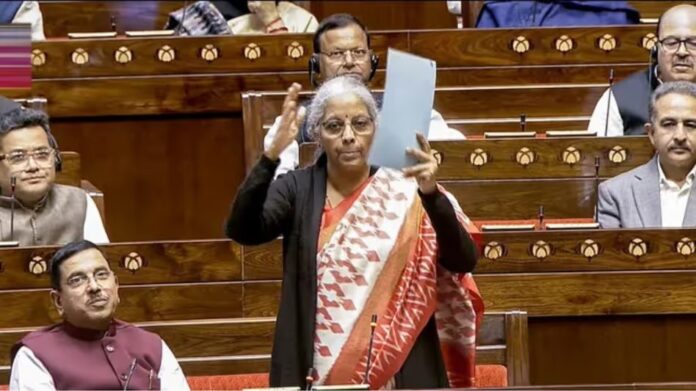
The Rajya Sabha on December 2 returned the Manipur Goods and Services Tax (GST) Bill to the Lok Sabha, completing a key step in integrating the northeastern state under the nationwide GST 2.0 reforms framework. The legislation, which seeks to replace an earlier Ordinance, had been passed by the Lok Sabha just one day prior. Responding to the debate in the Upper House, Finance Minister Nirmala Sitharaman strongly asserted that the legislation would deliver long-overdue benefits to the people and businesses of Manipur, while also strengthening revenue collection in the conflict-affected state.
Minister Sitharaman used the occasion to launch a sharp critique against the Opposition, accusing them of shedding “crocodile tears” over Manipur while repeatedly failing to participate in crucial Parliament discussions concerning the state’s development. She noted that the Opposition had similarly skipped a debate on Manipur’s budget and had again stayed away during the GST bill discussion. “Every time about Manipur they will raise these issues… total crocodile tears,” she remarked, emphasizing that the bill would eliminate ambiguities and extend to Manipur the economic reforms from which the rest of the country is already benefiting. The Finance Minister detailed that the GST 2.0 reforms include mechanisms such as track-and-trace systems and a rationalization of tax slabs, specifically mentioning the abolition of the 28 per cent slab and the relocation of several items to the 18 per cent category. She contended that these reforms would ease compliance, enhance transparency, and provide a much-needed boost to the Manipur government’s revenue, particularly following a prolonged period without an elected administration.
During the debate, BJD MP Sulata Deo called for the immediate lifting of President’s Rule in Manipur and the swift organization of elections. She also drew a global comparison, pointing out that India’s prior 28 per cent GST rate was the highest in the world, exceeding even that of Argentina. Supporting the bill, YSRCP MP Ayodhya Rami Reddy Alla highlighted that the reduced compliance burdens and increased transparency would enable Manipur to concentrate on sustainable development and keep pace with national economic progress. Citing official data, he noted a sharp decline in violent incidents in Manipur over the past decade—dropping from 740 in 2008 to 97 in 2020—but acknowledged that this positive trend was reversed in 2023, with approximately 260 deaths recorded by April 2025. He stressed that achieving long-term peace requires addressing systemic inequalities between the hill and valley regions, as well as between majoritarian and tribal communities. Nominated member Harsh Vardhan Shringla also voiced his support, stating that a stable and predictable GST regime would be crucial for attracting investment, improving state revenues, and supporting Manipur’s economic recovery as it continues to manage the ongoing ethnic violence between the Meitei and Kuki-Zo communities, which has killed over 260 people and displaced thousands since May 2023. The bill will now proceed back to the Lok Sabha for the final procedural approval before it is enacted into law.
