
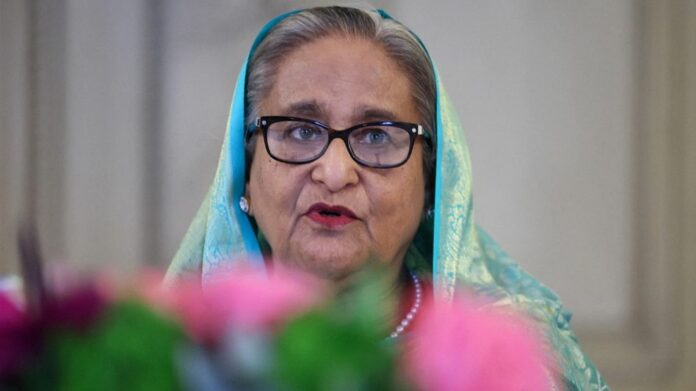
Former Bangladesh prime minister Sheikh Hasina has ruled out returning to the country under the present circumstances, saying the legal action against her is politically motivated and warning that Bangladesh is sliding further into instability amid continuing violence and unrest.
Hasina’s remarks came against the backdrop of fresh disorder last week, including the killing of a Hindu man, which she cited as evidence of worsening law and order since her removal from office. She said she would only consider returning once Bangladesh had what she described as a legitimate government and an independent judiciary, arguing that the current environment made a fair legal process impossible.
Accusing the interim administration led by Chief Adviser Muhammad Yunus of lacking democratic legitimacy, Hasina said state institutions were being used to target political opponents. She claimed the verdict delivered by the International Crimes Tribunal was not a genuine judicial exercise but a political manoeuvre aimed at removing her from public life. She alleged she had been denied basic rights of defence, including the freedom to appoint legal counsel, and said the tribunal was being used to pursue a broader campaign against the Awami League.
In November, the International Crimes Tribunal found Hasina guilty of crimes against humanity linked to the July–August 2024 uprising. Local media reported that International Crimes Tribunal-1 imposed the death penalty after convicting her on all five charges, concluding that Hasina and senior figures from her former government had enabled and directed atrocities during the protests.
Rejecting the ruling, Hasina said she continued to place faith in Bangladesh’s constitutional traditions, maintaining that justice could only be achieved once institutional independence was restored. She dismissed calls for her extradition, portraying them as signs of desperation within an unelected administration struggling to maintain control.
Hasina also questioned the credibility of elections scheduled for February, pointing to the continued ban on the Awami League. She argued that excluding a party with multiple national mandates would hollow out the electoral process, suppress voter participation and leave any resulting government without moral authority or public trust.
Addressing her departure from Bangladesh, Hasina said she had left to prevent further bloodshed rather than to evade accountability. She expressed appreciation for the hospitality extended to her by India, while warning that relations between Dhaka and New Delhi had deteriorated sharply under the interim administration.
She accused the current authorities of fuelling anti-India sentiment, failing to protect religious minorities and allowing extremist groups to influence both domestic and foreign policy. Describing India as Bangladesh’s most reliable partner for decades, she said bilateral ties rooted in history and geography would endure beyond the present crisis.
Raising concerns over the safety of Indian diplomats and missions, Hasina alleged that extremist elements emboldened under the Yunus administration had targeted embassies, media organisations and minority communities. She further claimed that convicted militants had been released and radical figures elevated to positions of authority, weakening the state’s ability to maintain order.
The killing of Sharif Usman Hadi, she said, underscored the scale of the breakdown in law and order, with violence becoming increasingly routine and damaging Bangladesh’s standing with its neighbours. She warned that a state unable to ensure basic internal security inevitably loses credibility internationally.
Hasina also voiced alarm over what she described as the growing influence of radical Islamist groups, claiming organisations linked to international terror networks were now operating openly. She said such groups projected moderation abroad while steadily radicalising institutions at home, a trend she argued should concern the wider region.
On rhetoric targeting India’s Siliguri Corridor, often referred to as the Chicken’s Neck, Hasina described such statements as reckless and unrepresentative of public opinion in Bangladesh, saying no responsible leadership would threaten a neighbour vital to trade and regional stability.
She further criticised the interim government’s outreach to Pakistan, arguing that while Bangladesh believed in friendly relations with all states, the current approach reflected diplomatic isolation and poor judgement rather than strategic balance. Reiterating her position, Hasina said the interim administration had no mandate to reshape Bangladesh’s long-term domestic or foreign policy, insisting that democratic legitimacy would be restored only when Bangladeshis were able to vote freely again.
