
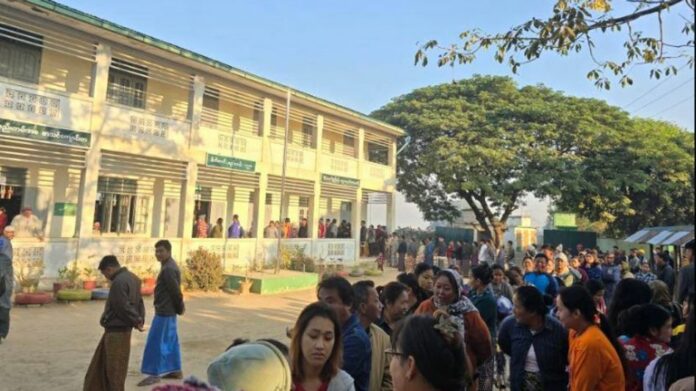
Myanmar, Dec 28: Voters in Myanmar cast their ballots on December 28 as the country launched the first phase of its general election, the first such exercise in five years and one conducted under the supervision of the military government amid an ongoing civil war. The polls, widely criticised by opponents and rights groups, mark the first election since the military overthrew the elected government of Aung San Suu Kyi in February 2021.
The election is being held in three stages, with voting in the initial phase taking place across 102 of Myanmar’s 330 townships. The remaining phases are scheduled for January 11 and January 25, with final results expected later in January. Polling stations were set up in high schools, government buildings and religious premises in Yangon, Naypyitaw and other areas, as authorities enforced tight security measures. Armed personnel were deployed outside polling centres, military vehicles patrolled major roads and electronic voting machines were used for the first time.
The exercise has drawn sharp criticism from analysts and opposition groups, who argue that it is designed to legitimise continued military control rather than facilitate a genuine democratic transition. Major political parties are absent from the contest, freedom of expression remains heavily curtailed and the broader environment has been described as deeply repressive. The military-aligned Union Solidarity and Development Party is expected to dominate the results, reinforcing doubts over the credibility of the process.
Aung San Suu Kyi, now 80, is not taking part in the election as she is serving a combined 27-year prison sentence on charges widely viewed as politically driven. Her National League for Democracy, which secured a landslide victory in the 2020 polls, was dissolved in 2023 after it refused to comply with new registration rules imposed by the military authorities. Several other parties have also stayed away from the polls, while opposition organisations have urged voters to boycott the process.
Election observers note that the absence of meaningful political choice has severely weakened the exercise. Amael Vier of the Asian Network for Free Elections pointed out that nearly three-quarters of voters in 2020 backed parties that are no longer allowed to contest. Although opposition groups and armed resistance organisations had threatened to disrupt voting, no major incidents were reported during the first phase.
Myanmar has remained gripped by violence since the military cracked down on nationwide protests against its takeover in 2021, triggering a protracted civil war. The United Nations estimates that more than 3.6 million people have been displaced, while rights groups report that over 22,000 individuals are detained for political reasons and more than 7,600 civilians have been killed by security forces. A recently enacted Election Protection Law has further restricted dissent by imposing harsh penalties on criticism of the electoral process.
UN High Commissioner for Human Rights Volker Türk has warned that violence and intimidation are intensifying across the country, saying the conditions required for free expression and peaceful assembly are absent. Despite the ongoing polls, both supporters and critics of the junta believe real power will continue to rest with Senior General Min Aung Hlaing, the architect of the 2021 coup. More than 4,800 candidates from 57 political parties are contesting national and regional seats, though only a handful of parties are competing nationwide with any realistic chance of parliamentary influence.
