
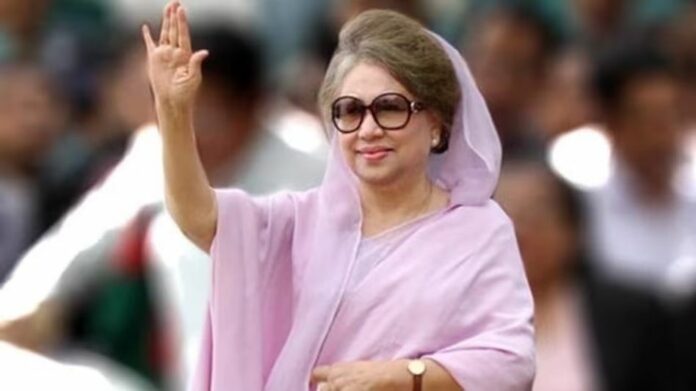
Dhaka, Dec 30: Khaleda Zia, Bangladesh’s first woman Prime Minister and one of the most influential figures in the country’s political history, died in Dhaka on December 30 following a prolonged illness, her party announced. She was 80.
The Bangladesh Nationalist Party said doctors pronounced her dead around 6 am at Evercare Hospital, where she had been admitted since November 23. She had been on ventilator support from December 11, and her health had deteriorated sharply in recent days. Her personal physician had earlier described her condition as extremely critical.
Medical sources said Zia had been battling multiple age-related complications, including advanced liver cirrhosis, diabetes, arthritis and serious cardiac and chest-related problems. Her condition worsened late on Monday night. Although arrangements had been made for a possible transfer to London on a special aircraft from Qatar, a medical board did not approve her movement from the hospital.
Her death came just weeks before Bangladesh’s scheduled national elections in February. Nomination papers had been filed on her behalf a day earlier for the Bogura-7 constituency. Her elder son, BNP acting chairman Tarique Rahman, who returned to Dhaka last week after spending 17 years in exile, is expected to play a central role in the polls and is contesting from Dhaka-17 and Bogura-6. Rahman had visited his mother at the hospital on Sunday and remained with her for over two hours.
Zia served as Prime Minister twice, first from 1991 to 1996 and again from 2001 to 2006, becoming the first woman to hold the office in Bangladesh. She was also the second woman, after Pakistan’s Benazir Bhutto, to head a democratically elected government in a Muslim-majority nation.
She was the widow of Ziaur Rahman, a former army chief, liberation war hero and Bangladesh’s sixth President, who founded the BNP in 1977 before being assassinated in 1981. Khaleda Zia assumed leadership of the party in 1984 and emerged as a key figure in the mass movement against the military regime of H M Ershad. During Ershad’s rule, she was detained several times for her political activities.
Following Ershad’s resignation amid widespread protests in 1990, elections held the next year brought Zia to power, restoring parliamentary democracy. Although her brief return to office in 1996 ended within weeks due to political unrest, she later led a four-party alliance to victory in 2001. She stepped down in 2006 and was arrested the following year on corruption charges.
Her governments were known for a strong focus on social welfare and education. Initiatives under her tenure included compulsory primary education, free schooling for girls up to secondary level, stipend schemes for female students and food-for-education programmes. She also oversaw an increase in the upper age limit for entry into government service.
Leaders from across Bangladesh’s political spectrum paid tribute as the country mourned the passing of a leader who dominated its political landscape for more than three decades and left a lasting imprint on its democratic journey.
