
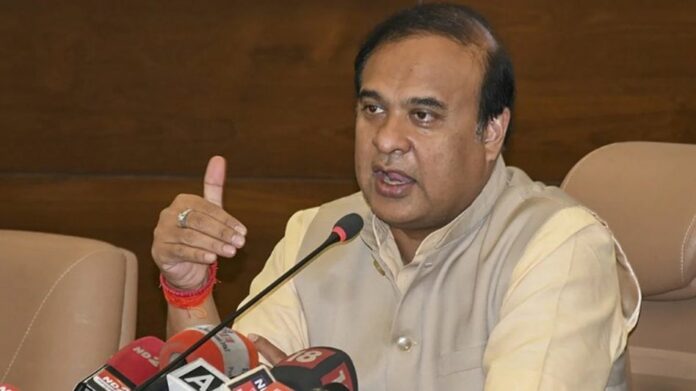
Guwahati, Dec 31: Assam Chief Minister Himanta Biswa Sarma has raised fresh concerns over demographic changes and the issue of illegal infiltration in eastern India, warning that the trend could have long-term implications for governance and security in the region. Speaking in a recent interview, Sarma pointed to the strategic sensitivity of areas around the Chicken’s Neck corridor, noting that populations living there often share deep cultural and familial links with neighbouring Bangladesh.
According to the Chief Minister, although these communities reside within Indian territory, their close connections through language, education, music and media create a situation that could become challenging during periods of heightened tension. He suggested that such linkages make the region particularly vulnerable, given its geographical and strategic importance.
Sarma also spoke at length about demographic changes in Assam, highlighting the steady rise in the Muslim population over several decades. Referring to observations made by the Supreme Court during a hearing related to the state, he said demographic shifts have been taking place since the 1940s, with a noticeable acceleration after 1961. Citing Census data, he said Muslims accounted for about 34 percent of Assam’s population in 2011 and claimed that, had the 2021 Census been conducted, the figure could have risen to around 38 percent. He further projected that the proportion may approach 40 percent if existing trends continue.
While acknowledging that illegal infiltration may have declined marginally over the past decade, Sarma argued that the reduction would not significantly alter the overall demographic picture. He warned that crossing a certain population threshold could eventually influence state institutions, including government administration and the police. “At best, I can delay this situation for about a decade, but there is no permanent solution,” he said.
The Chief Minister stressed that the issue is not confined to Assam alone, asserting that states across eastern India, including West Bengal and Jharkhand, are facing similar challenges. His remarks come at a time when debates around border management, population changes and their impact on local governance continue to dominate political and public discourse in the region.
