
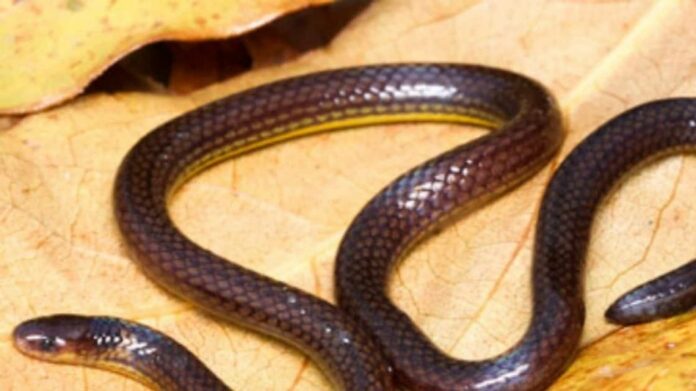
Aizawl, Jan 6: Scientists have identified a previously unknown species of reed snake in Mizoram, marking an important addition to India’s reptile diversity and resolving a taxonomic error that persisted for more than a decade. The discovery highlights the rich but still underexplored biodiversity of Northeast India.
The finding was made by a team of researchers from Mizoram working in collaboration with scientists from Russia, Germany and Vietnam. The new species has been named Calamaria mizoramensis, after the state where it was discovered, and the research detailing the discovery has been published in the international journal Zootaxa.
According to lead researcher Lalremanga, a professor in the Department of Zoology at Mizoram University, the identification followed extensive morphological studies and DNA analysis. Snakes collected from Mizoram since 2008 had earlier been misidentified as a common Southeast Asian species. The new study revealed that the Mizoram specimens represent a distinct evolutionary lineage found only in the region.
Genetic analysis showed that the newly identified snake differs by more than 15 per cent from its closest known relatives, a level of divergence that scientists consider sufficient to classify it as a separate species. Specimens used in the study were collected over a period of more than ten years from forested areas and locations around Aizawl, Reiek, Siphir and Sawleng.
At present, Calamaria mizoramensis is known only from Mizoram, though researchers say it may also occur in neighbouring states such as Manipur, Nagaland and Assam. Its possible presence in the Chittagong region of Bangladesh has also not been ruled out, given similar ecological conditions.
The genus Calamaria includes 69 recognised species worldwide, many of which are small, secretive and poorly studied. The newly described snake is non-venomous and harmless to humans. It is nocturnal and semi-fossorial, typically inhabiting humid forest environments. The species has been recorded at elevations between 670 and 1,295 metres above sea level and has even been found near human habitations, including the Mizoram University campus.
Based on current information, the researchers have provisionally classified the species as “Least Concern” under the IUCN Red List, noting its presence across multiple sites and the absence of any immediate, significant threats.
The study also underscored Mizoram’s remarkable herpetological diversity, with at least 169 species recorded so far, including 52 amphibians and 117 reptiles. Scientists stressed that continued biological surveys in the forested hill regions of Northeast India are essential, as many species remain undocumented or poorly understood.
