
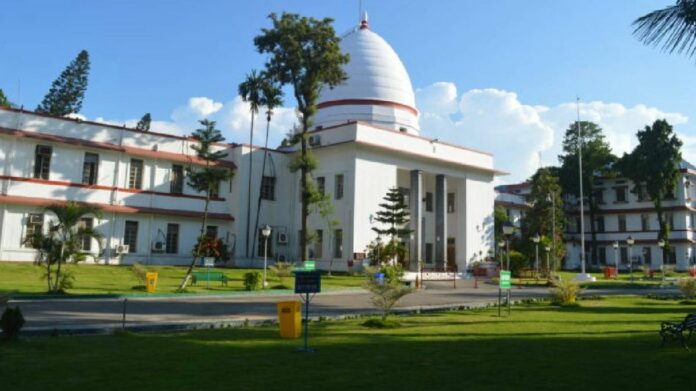
Guwahati, Jan 8: Opposition to the proposed relocation of the Gauhati High Court’s principal seat intensified on January 8 as members of the Gauhati High Court Bar Association (GHCBA) began a three-day hunger strike in Guwahati. The protest targets the state government’s plan to move the court to North Guwahati as part of a judicial township project at Rangmahal.
The hunger strike, scheduled for six hours each day, commenced at 10 am in front of the old High Court building at Uzan Bazar. It follows a resolution passed at an emergent extraordinary general meeting of the Bar Association earlier in the week. GHCBA president K N Choudhury is leading the protest, which the Association has described as a peaceful and democratic form of dissent.
The Assam government has proposed constructing a new High Court complex within a judicial township spanning 129 bighas, or over 42.5 acres, at Rangmahal on the northern bank of the Brahmaputra. The Chief Justice of India is slated to lay the foundation stone for the project on January 11. In response, the Bar Association has decided to boycott the ceremony and has urged all advocates to stay away from the event.
In its statement, the GHCBA reiterated that its general body, after detailed discussions, has consistently opposed shifting the principal seat from its existing location in central Guwahati. The Association said this stance reflects earlier resolutions and the outcome of a referendum conducted among its members. According to the GHCBA, relocating the court would cause significant inconvenience to lawyers, litigants and the general public.
The hunger strike is set to continue on January 10 and January 12 as well. Meanwhile, the state government has defended the move, noting that the Assam cabinet approved Rs 479 crore in November last year for the first phase of the judicial township. Officials have argued that vacating the current High Court land at Uzan Bazar is necessary for the broader Brahmaputra riverfront development plan.
At present, the Gauhati High Court operates from its historic main building and a newer multi-storey complex built a few years ago. The two structures, located on opposite sides of Mahatma Gandhi Road, are linked by an underground tunnel equipped with escalators. Despite these facilities, the Bar Association has maintained that shifting the court complex is unnecessary and has called for the project to be halted in the interest of all stakeholders.
