
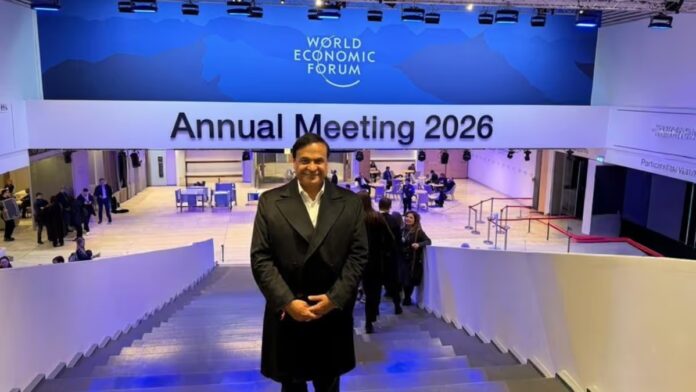
Assam Chief Minister Himanta Biswa Sarma on January 19 asserted that the state should be seen as a central pillar of the Northeast’s shared economic destiny, stressing that Assam’s development automatically generates growth across the entire region. Speaking on the sidelines of the World Economic Forum (WEF) annual meeting in Davos, Sarma said Assam’s economy is deeply intertwined with that of neighbouring northeastern states through geography, talent mobility and infrastructure linkages.
Rejecting the idea of viewing Assam in isolation, the chief minister said that large investments coming into the state are meant to benefit the broader Northeast. Referring to the proposed Tata semiconductor project, Sarma explained that although such industries may be physically located in Assam, their economic impact, employment opportunities and supply chains will extend across all northeastern states.
Describing Guwahati as the natural gateway to the region, Sarma said the city draws skilled manpower from across the Northeast, particularly because many states are predominantly hilly and face constraints in accommodating large-scale industrial projects. Assam’s vast plains and availability of land, he said, make it the most suitable destination for industrial expansion, creating opportunities for young people from the entire region. Every rupee invested in Assam, he added, effectively circulates throughout the Northeast.
On the semiconductor sector, Sarma said Tata’s entry has sparked fresh interest among global industry players. While no concrete proposal is currently under consideration, he confirmed that meetings with semiconductor industry leaders are scheduled, which are expected to help build momentum and strengthen the ecosystem in the state.
Turning to tourism, the chief minister said Assam has already attracted multiple investment offers for hotels and homestays. Although no new tourism-related memoranda of understanding will be signed at Davos, he said several MoUs are planned in Guwahati after his return, including proposals for five-star hotels in Guwahati city and Kaziranga.
Reflecting on the Advantage Assam 2.0 Investment and Infrastructure Summit held last year, Sarma said MoUs worth around Rs 5 lakh crore were signed, with investments of nearly Rs 3 lakh crore already grounded. He noted that land acquisition and project implementation have begun across sectors, while existing investors are expanding their commitments. He cited proposals to integrate pumped storage projects with solar power initiatives as evidence of growing confidence in Assam’s investment environment.
Sarma said Assam’s engagements at Davos are strongly focused on green and new energy sectors. He indicated that MoUs worth close to Rs 1 lakh crore are expected, mainly in pumped storage projects and innovative ventures such as converting bamboo into methanol, which he described as a unique opportunity for the state.
Calling Assam’s presence at the World Economic Forum a milestone, the chief minister said this is the first time the state is formally showcasing itself at Davos. The aim, he said, is to position Assam as an emerging economy that deserves attention alongside India’s traditional investment destinations. Citing recent Reserve Bank of India data, Sarma said Assam is officially the fastest-growing state in the country.
He also referred to the International Monetary Fund’s upward revision of India’s growth forecast to over seven percent, arguing that as India’s economy expands, investors should look beyond established regions. Sarma expressed confidence that Assam offers a strong, competitive and future-ready platform within India’s evolving economic landscape.
