
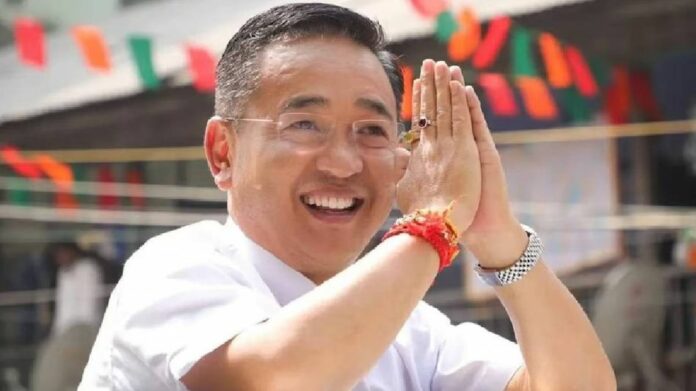
Sikkim Chief Minister Prem Singh Tamang on January 26 used his Republic Day address to outline the state government’s focus on expanding healthcare, addressing climate-related disaster risks and strengthening social protection, while reaffirming commitment to constitutional values and environmental conservation. Marking the 77th Republic Day, Tamang said the occasion honoured the sacrifices behind India’s freedom struggle and the Constitution that upholds justice, liberty, equality and fraternity.
Reflecting on Sikkim’s journey since its merger with the Indian Union in 1975, the chief minister said the state’s development model has been guided by balanced growth, social harmony and ecological responsibility. He highlighted significant progress in the healthcare sector, noting that Sikkim has transitioned from basic medical services to a comprehensive, multi-tier system that now includes super-speciality care. According to Tamang, advanced procedures such as cancer surgeries and cardiac interventions are being carried out within the state, reducing the need for patients to seek treatment elsewhere. He cited the establishment of Sikkim’s first tertiary cancer care centre and the expansion of dialysis facilities across districts as major achievements.
Raising concern over the increasing incidence of cancer, Tamang said the state is collaborating with national institutions to strengthen screening and early detection programmes. He announced free HPV vaccination for all 14-year-old girls and the provision of self-testing kits for women aged between 30 and 65, describing cervical cancer as both preventable and treatable if detected early.
Education was identified as another cornerstone of development, with the chief minister pointing to Sikkim’s literacy rate of over 90 per cent and a favourable teacher–student ratio. He said the state has become the first in the country to introduce kindergarten in all government schools and has recorded improved board examination results through focused mentoring initiatives. The introduction of locally relevant textbooks and investments in digital governance were highlighted as measures aimed at strengthening learning outcomes.
On infrastructure, Tamang said road connectivity remains vital for a mountainous border state like Sikkim, but stressed that the focus is now shifting towards quality, safety and climate resilience rather than expansion alone. He said the government is prioritising landslide mitigation, improved drainage systems and the use of durable materials to minimise disruptions and disaster-related damage.
Climate change emerged as a central theme of the address, particularly the growing threat of glacial lake outburst floods. Referring to the South Lhonak glacial flood of October 2023, Tamang said more than 40 glacial lakes in Sikkim have been identified as high risk. He emphasised the importance of scientific planning and a coordinated, whole-of-government approach involving experts from multiple disciplines to address these challenges.
Linking climate resilience with livelihoods, the chief minister spoke about renewed efforts to revive large cardamom cultivation, a traditional cash crop affected by disease and environmental stress. He said farmer-led field laboratories and disease-tolerant trials under the ‘Mero Alaichi Mero Dhan’ mission are showing encouraging early results.
On social security, Tamang reiterated a policy of zero tolerance towards crimes against women and children, expansion of CCTV surveillance and the strengthening of women’s helplines. He also reaffirmed welfare initiatives for mothers, senior citizens, persons with disabilities and pensioners, along with schemes aimed at improving women’s mobility and financial security.
Environmental protection and sanitation were also underscored, with the chief minister recalling Sikkim’s distinction as India’s first fully organic state and an early achiever of open defecation-free status. He said decentralised waste management systems and community-driven cleanliness initiatives continue to inform state policy.
Concluding his address, Tamang said Republic Day serves as an opportunity to renew faith in the Constitution and expressed confidence that Sikkim would continue to emerge as a model Himalayan state, contributing both to national integration and security while preserving its fragile ecology.
