
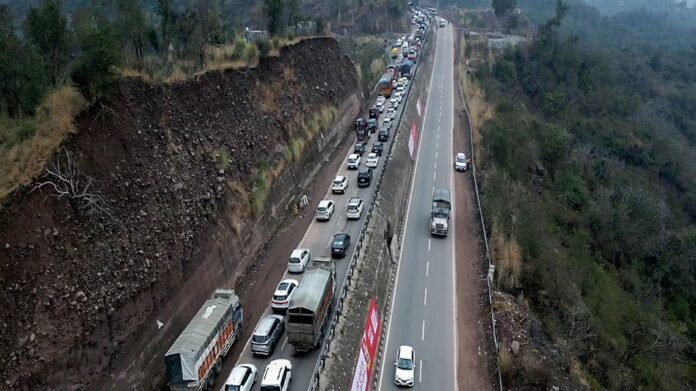
Gangtok, Jan 27: Tourist flow to North Sikkim has returned to near-normal levels following the reopening of the Toong–Naga Road, a vital route that had remained disrupted for months after the devastating glacial lake outburst flood (GLOF) of October 2023. The restoration of the road has brought renewed momentum to the region’s tourism-dependent economy and a sense of relief to local communities.
Chairman of the Sikkim Welfare Commission, Nim Tshering Lepcha, said travel towards Lachung has stabilised, with nearly 400 tourist vehicles now entering the area daily. He noted that significant improvement in road conditions has ensured smooth and safe movement, benefitting both visitors and residents whose livelihoods are closely tied to tourism. With Lachung accessible again, focus has shifted to Lachen, which is still closed to tourists.
Lepcha said work is underway to restore connectivity to Lachen, with the Border Roads Organisation constructing a bridge over the Taram Chu River. The project is expected to be completed by the first week of February, after which tourist access to Lachen will also be reopened, further strengthening recovery efforts in North Sikkim.
Rehabilitation of families displaced by the disaster has also reached a crucial stage. According to Lepcha, 125 families from the severely affected Rel, Naga and Toong wards will be relocated to Upper Bojoghari in Gangtok. Distribution of land parchas is scheduled for February 8, enabling the construction of permanent housing for those who lost their homes.
The Toong–Naga stretch was among the worst-hit areas during the October 2023 GLOF, which triggered widespread destruction along the Teesta basin, washing away roads, bridges and settlements. Subsequent landslides further damaged the route, cutting off access and forcing several families to abandon their villages.
Officials described the reopening of the road as a major milestone, marking progress not only in reviving tourism but also in advancing long-term rehabilitation and resettlement plans. The state government has reiterated that ensuring safety, dignity and sustainable livelihoods for affected families remains central to its recovery strategy.
In the aftermath of the disaster, the Indian Army under the Trishakti Corps played a key role in supporting civil authorities through evacuations, medical assistance, debris clearance and the restoration of essential road links. Temporary connectivity was established to maintain the supply of essentials to remote areas, helping stabilise the region during a prolonged period of disruption.
