
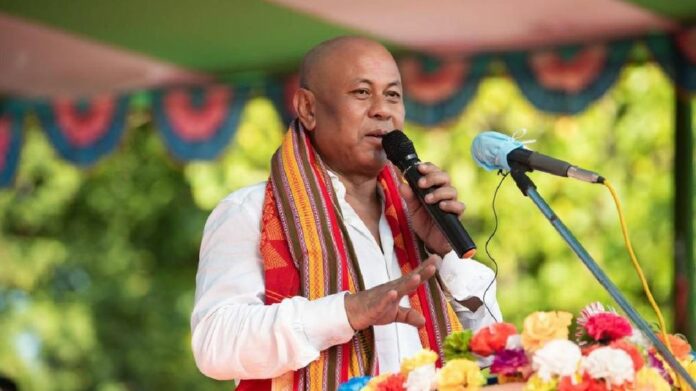
Guwahati, Jan 28: Bodoland People’s Front (BPF) chief and Bodoland Territorial Council (BTC) Chief Executive Member Hagrama Mohilary on Tuesday asserted that the unfinished commitments of the historic Bodo Peace Accord would soon be taken up with both the Assam government and the Centre, stressing that the responsibility for full implementation rests with the two governments.
Speaking on the occasion of the 6th Bodo Peace Accord Day on January 27, Mohilary said the anniversary served as a reminder of the assurances made to the Bodo people under the agreement. He underlined that while peace had returned to the region, several clauses of the accord remained unfulfilled.
The third and most comprehensive Bodo Peace Accord, signed on January 27, 2020, was a tripartite agreement between the Government of India, the Government of Assam and Bodo organisations, including all factions of the National Democratic Front of Bodoland (NDFB). The accord had brought an end to decades of insurgency and laid the groundwork for peace and development in the region.
The sixth anniversary was marked by day-long programmes organised by the BPF-led BTC at the BTC Legislative Assembly Auditorium, Bodofa Nwgwr, in Kokrajhar, with the participation of political leaders, civil society members and representatives of the Bodo community.
Addressing the gathering, Mohilary said that the state and central governments were duty-bound to fulfil the remaining provisions of the agreement signed with the All Bodo Students’ Union (ABSU), NDFB and the United People’s Party Liberal (UPPL). He pointed out that key issues were still pending, including enhanced financial and administrative autonomy for the BTC through the proposed 125th Constitutional Amendment.
Other unresolved matters, he said, included granting ST (Hills) status to Bodo-Kachari communities in Dima Hasao and Karbi Anglong districts, expansion of the Bodoland Territorial Region (BTR) through the inclusion of additional villages, complete rehabilitation of former NDFB cadres, the release of certain individuals linked to the armed movement, and reforms in council, municipal and village-level governance structures.
Acknowledging delays in implementation, Mohilary said he would raise the issues with the Assam government at the earliest. He added that the development commitments outlined in the accord would be implemented in a phased manner.
The Bodo Peace Accord continues to be seen as a landmark in Assam’s peace process, with stakeholders maintaining that full implementation is essential for lasting peace, political stability and inclusive development in the Bodoland region.
