
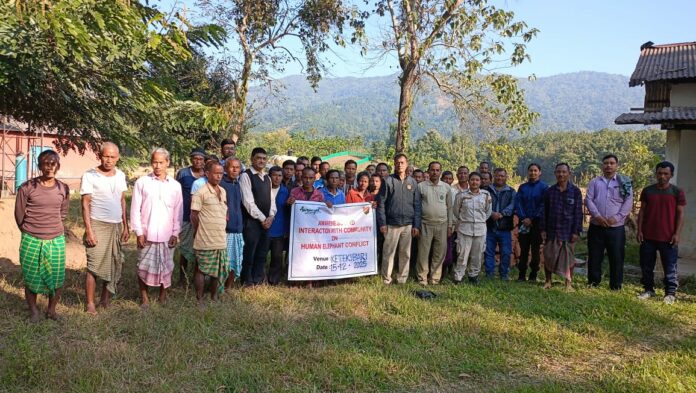
Goalpara: Premier biodiversity organisation Aaranyak, in partnership with the Krishnai Forest Range, organised an awareness programme in Ketekibari village near the Assam–Meghalaya border to promote environmental conservation and strengthen efforts to mitigate human–elephant conflict (HEC) in the region.
Ketekibari and nearby villages—including Chaplengkata, Thakurbila and Borjhora—lie along the inter-state boundary between Goalpara district and West Garo Hills. The villages are inhabited largely by Rabha and Garo communities, who have faced repeated incidents of elephant depredation, crop destruction and night-long distress for many years. The meeting sought to build understanding among villagers on both sides of the border and encourage cooperation in driving elephants safely without harm. Around 50 participants from Assam and Meghalaya attended, including Nokmas from the Garo Hills, Gaon Burhas and local farmers, many of whom openly shared their experiences and concerns.
Also Read: CIJWS, Assam University Plan Tie-Up for Skill and AI Training
The Krishnai Forest Range team consisted of Dy. Ranger Rajib Kataki, Forester-I Jitan Talukdar, and Forest Guards Barasha Gogoi and Gitali Borah. Aaranyak was represented by Anjan Baruah, Subhas Chandra Rabha, Manjit Das, Ripunjoy Nath and Bijoy Kalita. The programme, moderated by Subhas Rabha, featured a presentation by Anjan Baruah on potential HEC-mitigation strategies, daily precautions and coexistence practices, supported by slides and visual material. Officials from the Forest Department interacted closely with villagers, encouraging them to report elephant movements promptly. Community members from the Garo Hills said they had not received mitigation tools from the Meghalaya side and appealed for support, while participants in Assam requested additional torchlights and solar lighting to help with night patrolling.
Despite the challenges, the meeting ended on a positive note, with residents of both states expressing solidarity and agreeing to work together. They stressed that cooperation between boundary communities, along with forest personnel, is essential to keep people safe while allowing elephants to move without obstruction. Organisers said the event was an important step toward creating a shared platform for dialogue, confidence-building and practical solutions—laying the groundwork for peaceful coexistence between humans and elephants in one of the region’s most sensitive wildlife corridors.
