
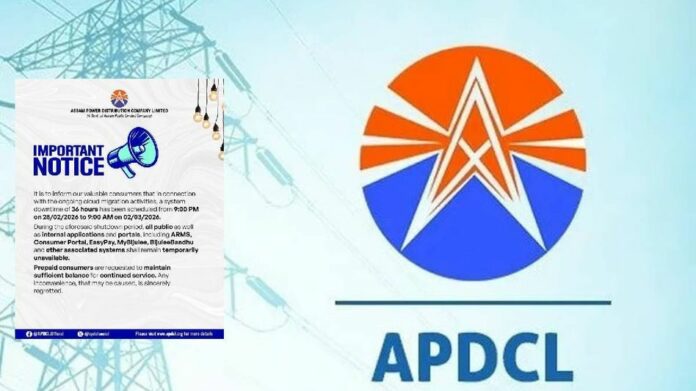
Guwahati, Feb 26: The Assam Power Distribution Company Limited (APDCL) has announced a significant, 36-hour scheduled suspension of its entire digital infrastructure to facilitate a major migration to cloud-based systems. According to an official communication released on February 25, the utility provider will take all public-facing services and internal operational systems offline starting at 9 pm on February 28. This comprehensive maintenance window is expected to conclude by 9 am on March 2, marking a critical step in the company’s efforts to modernize its technological backbone for improved efficiency and scalability.
During this period, consumers across Assam will experience a total blackout of digital interaction points. The shutdown will impact a wide array of essential platforms, including the ARMS system, the Consumer Portal, EasyPay, MyBijulee, and BijuleeBandhu, as well as various integrated applications within the utility’s ecosystem. Consequently, users will be unable to access these portals for routine tasks such as bill payments, account management, complaint registration, or electricity recharges. The suspension is designed to be uniform, affecting not only consumer-facing apps but also the internal administrative systems that manage backend processes and field operations.
In light of the impending downtime, APDCL has issued a specific advisory for prepaid electricity consumers to prevent any unintended loss of power. Households and commercial establishments utilizing prepaid smart metering systems are strongly urged to ensure their accounts have adequate credit balances before the February 28 deadline. Because recharge services will be entirely unavailable during the 36-hour migration window, proactive top-ups are essential to maintaining continuous power supply throughout the weekend.
While expressing regret for the temporary inconvenience, APDCL emphasized that shifting to a cloud-based infrastructure is a vital move for the future of the state’s power distribution. The upgrade is intended to bolster system resilience, enhance data security, and significantly reduce the risk of future unplanned outages. By transitioning to this more robust, technology-driven model, the utility aims to provide more reliable service delivery and a smoother integration process for upcoming digital features.
