
ITANAGAR, Oct 4: Arunachal Pradesh is exploring geothermal energy as a clean, locally generated power source, particularly for remote and strategically located border areas, Science and Technology Minister Dasanglu Pul said on October 3.
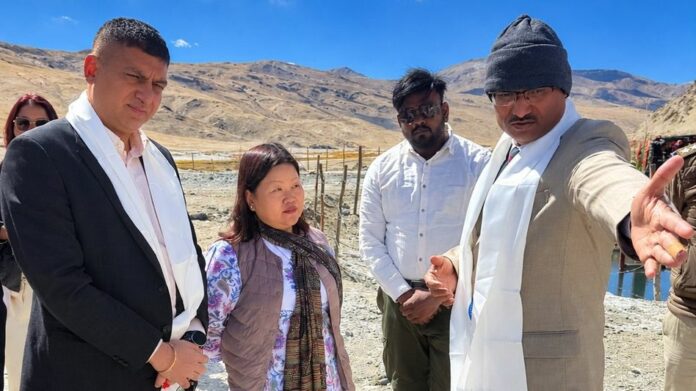
Pul, along with Centre for Earth Sciences and Himalayan Studies (CESHS) Director Tana Tage and departmental geologists, visited the ONGC Geothermal Project at Puga Valley in Ladakh to study geothermal exploration, drilling and power generation under high-altitude Himalayan conditions.
The visit came as Arunachal Pradesh stepped up efforts to assess its own geothermal resources. The Mago-Thingbu belt in Tawang district has been identified as a promising zone, with the state estimating a potential of around 10-15 MW.
Scientific investigations into the state’s geothermal resources have been underway for several years. In March 2024, CESHS, in collaboration with the Norwegian Geotechnical Institute and Iceland-based Geotropy, conducted field investigations and geological structural mapping at hot-spring sites in Mago, Thingbu and other areas.
The studies have assessed the suitability of geothermal resources for electricity generation and other applications, including heating and cooling and drying agricultural produce.
CESHS and Oil India Limited later initiated pre-feasibility studies involving surface and subsurface investigations at Mago, Thingbu, Damteng and Tsechu in Tawang district.
Field investigations were also conducted at five geothermal sites — Damteng, Grengkhar, Mago, Thingbu and Tsechu — where samples were collected for geochemical analysis.
“Arunachal Pradesh is blessed with immense natural resources, and our endeavour is to harness this potential responsibly for a sustainable future,” Pul said.
She said technical insights gained from the Puga project would help strengthen Arunachal Pradesh’s efforts to assess and develop its geothermal potential, particularly in remote and border areas where conventional power infrastructure could be challenging.
Pul also acknowledged ONGC and its execution partner SEROS for sharing technical expertise and field experience during the visit.
