
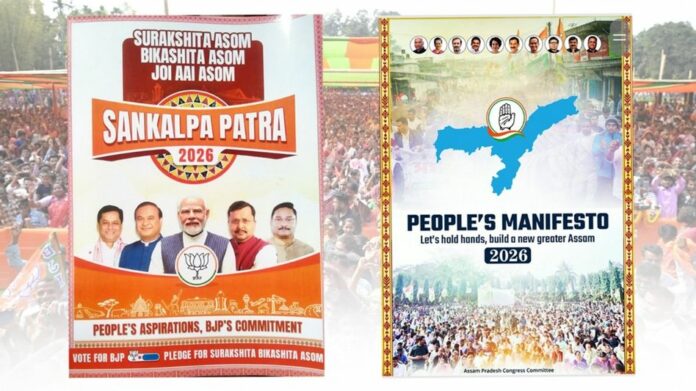
Guwahati, April 9: With polling set for April 9, the electoral contest in Assam has crystallised into a clear ideological and policy divide between the Bharatiya Janata Party and the Indian National Congress, as reflected in their respective manifestos. Far from being routine policy documents, the BJP’s Sankalp Patra and Congress’s People’s Manifesto outline contrasting narratives on governance, identity, economy, and welfare.
The BJP frames its campaign around performance and continuity, opening its manifesto with data-driven comparisons between the UPA and NDA eras. It highlights economic growth, infrastructure expansion, and welfare delivery as evidence of transformation under the leadership of Chief Minister Himanta Biswa Sarma. Congress, led in the state by Gaurav Gogoi, adopts a forward-looking approach, beginning with direct welfare assurances and positioning itself as an alternative to what it describes as a decade of misgovernance.
On identity and governance, the BJP emphasises protection of indigenous rights through measures such as implementation of the Immigrants (Expulsion from Assam) Act, proposals for a Uniform Civil Code, and legislative action on issues it terms “Love Jihad” and “Land Jihad.” Congress, in contrast, frames identity within a broader, inclusive narrative, focusing on land rights, constitutional safeguards, and what it calls a “shared Assamese identity,” without direct reference to illegal immigration.
Women voters emerge as a central constituency for both parties. The BJP promises an expansion of its Orunodoi scheme, increasing financial assistance to ₹3,000 per month and extending coverage. Congress counters with a universal cash transfer proposal for all women, alongside commitments to higher reservations in government jobs and structural support for entrepreneurship and welfare.
Economic priorities also diverge in approach. The BJP sets ambitious macro targets, including scaling Assam’s economy to $150 billion by 2031, backed by ₹5 lakh crore in infrastructure investments and major industrial projects such as semiconductor manufacturing. Congress focuses on reviving traditional industries, strengthening small enterprises, and promoting decentralised growth through agriculture, cooperatives, and regional industrial corridors.
In healthcare, the BJP proposes a ₹50,000 crore investment plan to expand hospital infrastructure and specialised treatment facilities, while Congress promises universal health coverage of up to ₹25 lakh per family, alongside reforms aimed at improving accessibility and primary care delivery.
Employment and youth development remain key battlegrounds. The BJP pledges two lakh government jobs and expanded entrepreneurship schemes, while Congress promises time-bound recruitment processes, startup funding, and targeted initiatives in education and cultural sectors, including programmes named after Zubeen Garg.
Both parties also prioritise tea garden communities, offering wage increases, land rights, and welfare expansion, though Congress proposes structural changes such as recognising tea as a primary industry with industrial wage standards. On flood management, a persistent issue in the state, the BJP outlines a ₹18,000 crore mission with defined interventions, while Congress proposes a broader climate resilience framework.
Governance models further underline the contrast. Congress foregrounds anti-corruption measures, including an independent oversight body and citizen-centric reforms. The BJP, on the other hand, focuses on administrative efficiency, digital governance, and institutional expansion, including proposals for a second capital in Dibrugarh and decentralised administrative units.
Despite the breadth of commitments, both manifestos leave questions around fiscal sustainability largely unaddressed, with proposed expenditures significantly exceeding current budgetary capacities.
At its core, the contest reflects two distinct political propositions: the BJP’s emphasis on continuity, delivery, and central-state synergy, versus Congress’s appeal centred on redistribution, inclusion, and institutional correction. As campaigning enters its final phase, the outcome may hinge on whether voters prioritise demonstrated performance or the promise of systemic change.
