
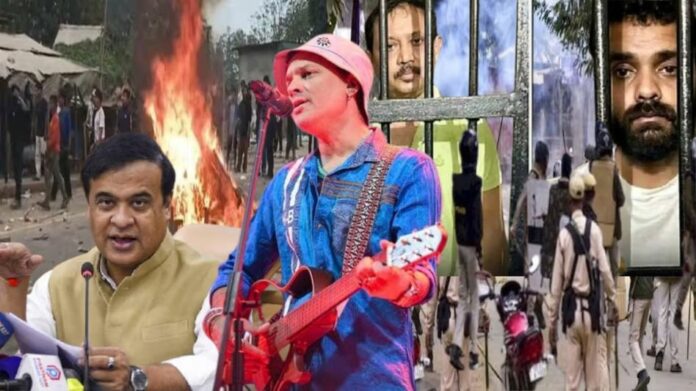
Grief, confrontation and unresolved tensions shaped Assam’s public life through 2025, leaving the state deeply unsettled as it heads toward the 2026 Assembly elections. From the death of a cultural icon that sparked unprecedented protests to escalating political rhetoric and fresh ethnic violence, the year was marked by moments that eclipsed routine governance and policy debates.
The most defining event was the death of legendary Assamese singer Zubeen Garg in September, an incident that plunged the state into collective mourning and ignited a criminal case with far-reaching political and social consequences. Garg, 52, died on September 19 while swimming in Singapore during the North East India Festival. His sudden death immediately raised suspicions. As his body was flown back, lakhs of people lined the streets, and for three days mourners gathered at a stadium to pay their respects before his cremation. What began as grief soon turned into anger, with mass protests demanding justice.
Under intense public pressure, the government constituted a Special Investigation Team, which filed a chargesheet on December 12. The SIT accused festival director Shyamkanu Mahanta, Garg’s manager Siddhartha Sharma, and band members Shekharjyoti Goswami and Amritprava Mahanta of murder. Garg’s cousin Sandipan Garg, an Assam Police official, was charged with culpable homicide not amounting to murder, while two personal security officers were booked for criminal conspiracy. The case quickly took on political overtones, amplified by a massive social media campaign under #JusticeForZubeenGarg, one of the most engaged online movements the state has seen. The government has promised to seek a fast-tracked trial, which has already begun.
In a poignant postscript, Garg’s final film, Roi Roi Binale, was released on October 31 as per his plans and went on to become the highest-grossing Assamese film to date, offering a moment of cultural pride amid turmoil.
As elections draw closer, the political temperature rose sharply. Chief Minister Himanta Biswa Sarma courted controversy by alleging that Deputy Leader of the Opposition Gaurav Gogoi and his British wife Elizabeth Colburn had links with Pakistan’s intelligence agency, the ISI. An SIT submitted its report on September 10, with Sarma claiming it contained “startling facts” suggesting a conspiracy against national sovereignty. Gogoi dismissed the allegations as a “C-grade Bollywood film” and accused the government of manufacturing charges for electoral gain. Opposition parties echoed this view, with eight parties announcing plans to fight the 2026 polls together.
Throughout the year, Sarma campaigned aggressively on issues of infiltration and land encroachment, ordering eviction drives in forest areas and Vaishnavite monastery lands allegedly occupied by Bengali-speaking Muslims. He claimed that 35 to 40 people were being “pushed back” every week. The tabling of reports by the Tewary and Mehta Commissions—linked to violence around the 1983 elections, including the Nellie massacre—was widely seen by observers as politically timed. Bills on polygamy, land rights for tea garden workers and proposals related to Scheduled Tribe status for six communities were also viewed through an electoral lens.
While the BJP-led alliance swept the panchayat elections, it suffered a setback in the Bodoland Territorial Council polls, losing power to the Bodoland People’s Front, which later aligned with the NDA.
The year ended with fresh violence that underlined Assam’s fragile peace. In late December, West Karbi Anglong district witnessed deadly clashes over land rights and ethnic identity. Two people were killed and more than 70 injured—over 60 of them police personnel—in violence between Karbi and Bihari communities. The unrest followed a hunger strike by Karbi organisations demanding the eviction of alleged illegal settlers from Village Grazing Reserve and Professional Grazing Reserve lands, which are protected under the Sixth Schedule.
When authorities attempted to remove hunger strikers at Kheroni on December 22, protests spiralled out of control. The ancestral home of Karbi Anglong Autonomous Council Chief Executive Member Tuliram Ronghang was torched, shops were set ablaze, and violence spread across the area. One protester died during police action, while a differently-abled man was burnt alive inside a shop. Security forces faced stone-pelting, crude bombs and even arrows. Director General of Police Harmeet Singh and an Inspector General were among those injured.
The Army was deployed for flag marches, mobile internet services were suspended, and prohibitory orders were imposed across Karbi Anglong and West Karbi Anglong. While the chief minister acknowledged the demand for evictions, he cited a Gauhati High Court stay that prevented immediate action. A tripartite meeting involving the state government, the autonomous council and agitating groups has been scheduled.
Amid the turbulence, Assam also marked moments of cultural affirmation. Year-long centenary celebrations of Bharat Ratna Bhupen Hazarika were launched in September, inaugurated by Prime Minister Narendra Modi, with events planned across the country. President Droupadi Murmu is expected to attend the concluding समारोह in 2026. The government also highlighted welfare initiatives for women, girls and students, with claims that nearly 1.5 lakh jobs were provided over the past five years.
As 2025 draws to a close, Assam stands defined by contradiction—cultural celebration alongside deep grief, welfare claims amid hard-edged politics, and cinematic success shadowed by violence. With the legacy of Zubeen Garg’s death, an intensifying political battle and unresolved unrest in districts like West Karbi Anglong, the state enters the new year carrying more questions than closure.
