
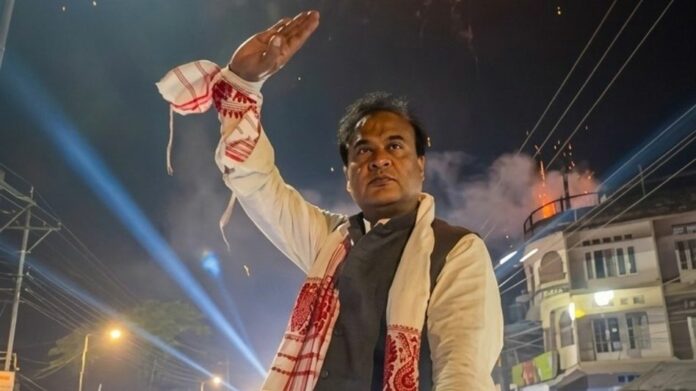
Guwahati, March 10: A recent public opinion survey conducted by Vote Vibe LLP under its State Vibe series indicates that the ruling National Democratic Alliance (NDA) government in Assam maintains majority approval ahead of the 2026 Assembly elections, with Chief Minister Himanta Biswa Sarma holding a slight edge over Congress leader Gaurav Gogoi in the race for the state’s top post.
The survey, carried out through Computer-Assisted Telephone Interviews of 2,616 respondents across Assam, included 52% male and 48% female participants, with 80% from rural areas. Social representation encompassed SC (7%), ST (12%), OBC (19%), General (22%), Muslims (35%), Christians (4%) and others (1%). Youth aged 18–24 made up 22% of the sample, while seniors 55 and above comprised 18%.
According to the findings, 55.6% of respondents rated the government’s performance as “Excellent” or “Good.” Satisfaction levels varied across communities, with Scheduled Castes showing the highest approval at 71%, while Muslim respondents were more critical, with only 44% rating the government positively. Senior citizens displayed the strongest support at 66%, whereas younger voters were comparatively more critical, with 56% expressing satisfaction.
In the race for the next chief minister, Sarma led with 46.6% support, while Gogoi received 41.7%. The survey revealed a stark generational divide, with Gogoi preferred by 61% of voters aged 18–24, compared to just 25% for Sarma. Social group preferences further highlighted the divide: Sarma enjoyed strong backing among General (79%), OBC (69%), and SC (72%) voters, whereas Gogoi commanded 65% support among Muslims. Gender differences were also noted, with women favouring Sarma (51% vs 36%) and men slightly leaning toward Gogoi (47% vs 43%).
Voters identified unemployment as the top concern, cited by 25.6%, particularly among youth and Muslim respondents. Floods and rehabilitation followed at 19.6%, reflecting Assam’s seasonal vulnerabilities, while alcoholism and drug abuse ranked third at 12.9%, peaking at 20% among OBC voters. Other issues included corruption (9.9%) and the investigation into the death of singer Zubeen Garg (7.4%).
The government’s most appreciated achievements were in law and order (20.5%) and infrastructure development (20.4%), together forming 40.9% of the positive perception. Despite this, rising prices emerged as the primary grievance (36.3%), followed by unemployment (27.1%), accounting for nearly two-thirds of voter dissatisfaction. Concern over inflation was particularly high among voters aged 35–44, reaching 49%.
The survey also assessed public opinion on Sarma’s controversial remarks involving the term “Miya,” finding that 55.4% of respondents supported the statement either fully or somewhat, while 21.7% opposed it and 22.8% remained neutral. Support was highest among General (83%), OBC (70%), and SC (77%) communities, with Muslim respondents largely critical (44% opposed). Women and senior citizens showed stronger backing for the statement than men and younger voters.
Regarding the government’s cash transfer schemes targeting youth, women, and tea garden workers, 54.2% believed these measures were electorally beneficial for the BJP, either by consolidating its base or attracting opposition voters. However, 15.8% expressed concern over fiscal strain, with Muslim respondents (26%) and seniors (29%) showing the highest apprehension.
Overall, the survey portrays the NDA entering the 2026 election cycle with solid public approval, with Himanta Biswa Sarma leading the chief minister preference. Yet, the data highlights strong support for Congress among younger voters and minority communities, pointing to a potentially competitive electoral contest. Analysts describe the upcoming elections as both a “pro-incumbency test” for the BJP and a “comeback test” for Congress, setting the stage for a closely fought battle in Assam.
