
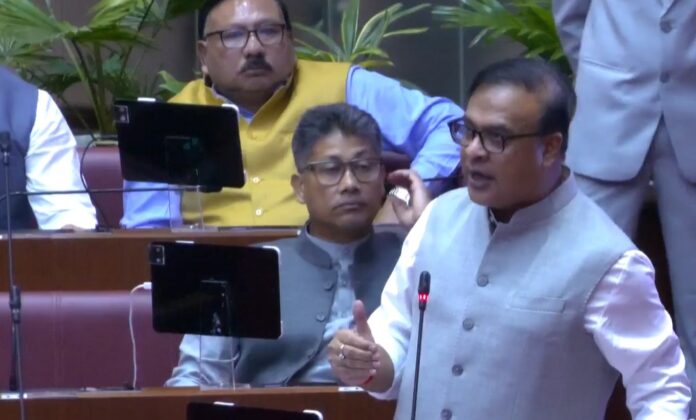
Assam Chief Minister Himanta Biswa Sarma on 25 November introduced the Assam Prohibition of Polygamy Bill, 2025 in the state Assembly, signalling a crucial move toward banning the practice in the state. The bill was tabled with the permission of Speaker Biswajit Daimary on the opening day of the Winter Session.
The bill was presented in the absence of Opposition MLAs from the Congress, CPI(M) and Raijor Dal, who walked out of the House shortly before its introduction. Their exit followed a discussion related to the death of Assamese singer Zubeen Garg. The proposed legislation will be taken up for detailed discussion and passage at a later stage.
Alongside the bill, Chief Minister Sarma also laid the report of the Justice (Retd.) T.U. Mehta Commission, an inquiry panel that examined widespread violence linked to the 1983 Assembly elections. The commission was formed by Mukti Jujaru Sanmilan and participants of the Assam Movement to investigate incidents during the anti-influx agitation between 1979 and 1985. The period marked one of Assam’s darkest phases, including the Nellie massacre of February 1983, where more than 2,100 people were killed in a single night. No discussion was held after the report was placed before the House.
The government further distributed printed copies of the Tewary Commission report, which also investigated the 1983 disturbances and the Nellie massacre. Led by retired IAS officer T.P. Tewary, the commission was formed on 14 July 1983 and submitted its findings to the Congress government in May 1984. The report was tabled in the Assembly in 1987 during the AGP regime.
Chief Minister Sarma earlier stated that despite being tabled decades ago, the report had never been made accessible to most legislators, with only a single copy kept with the Speaker. A recent Cabinet directive instructed that both printed and digital copies be made available to all members during the ongoing Winter Session to ensure access. As clarified by Sarma, no discussion will be held on the Tewary Commission findings.
The first day of the session therefore marked the introduction of a major social reform bill along with the circulation of two key historical reports documenting one of the most volatile chapters in Assam’s political history.
