
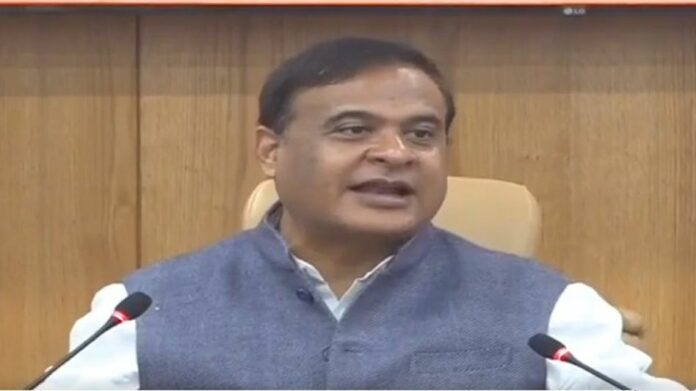
Guwahati, Feb 15: Assam Chief Minister Himanta Biswa Sarma on February 15 unveiled detailed plans for the Centre-approved ₹18,662.02-crore Gohpur–Numaligarh rail-cum-road underwater tunnel, describing the ambitious venture as a major achievement for the state and a landmark in engineering development. He termed the project a transformative step that will redefine connectivity and infrastructure capacity in Assam.
Cleared by the Central Government, the project will be India’s first underwater tunnel designed for both rail and road transport. It will also become the fourth rail-cum-road crossing over the Brahmaputra River and only the second such integrated structure globally after the Fehmarnbelt Fixed Link connecting Germany and Denmark.
Spanning 33.7 kilometres, the corridor will link Gohpur on NH-15 along the North Bank to Numaligarh on NH-715 on the South Bank. The alignment includes a 15.79-kilometre underwater tunnel beneath the riverbed and 17.91 kilometres of approach roads—10.15 kilometres on the Gohpur side and 7.76 kilometres on the Numaligarh side. Authorities have fixed a five-year timeline for completion.
The construction cost has been pegged at ₹11,982.36 crore, while the total capital outlay stands at ₹18,662.02 crore. Funding will be shared between the Ministry of Road Transport and Highways and the Ministry of Defence in an 80:20 ratio. The Assam government will shoulder half of the state GST component on the construction cost, amounting to approximately ₹539 crore.
Designed as a twin-tube structure, the tunnel will comprise two separate tubes, each accommodating a two-lane highway. One of the tubes will incorporate a railway track embedded within the roadway, allowing it to function as a rail-cum-road passage. Under normal conditions, the tunnel will operate as a four-lane road. During emergencies, one tube can be adapted for railway use, effectively converting the system into a two-lane road with a single railway line. For safety, cross passages will be installed every 500 metres. The tunnel will run at a depth of 52 to 57 metres below the riverbed.
On the railway front, the new link will connect the Rangia–Murkongselek section under the Rangia Division of Northeast Frontier Railway on the Gohpur side with the Furkating–Mariani loop line section under the Tinsukia Division on the Numaligarh side, strengthening rail connectivity across the region.
The Chief Minister revealed that the proposal was initially conceived as a road-only tunnel estimated at around ₹11,000 crore. However, after discussions with Prime Minister Narendra Modi, the project was expanded to incorporate a railway component, resulting in the present integrated structure with a revised total cost of ₹18,662 crore.
Implementation will be undertaken by the National Highways Authority of India, which will retain overall administrative control. NHAI DCL will manage road operations, while Indian Railways will oversee railway services. The execution process will involve coordination among the state government, the Ministry of Defence, and Indian Railways. Land acquisition is expected to commence within the next few days.
Highlighting its transformative impact, Sarma said the existing 240-kilometre journey between Gohpur and Numaligarh, which currently takes nearly six hours, will shrink to just 34 kilometres, reducing travel time to around 20 minutes and effectively doubling average travel speed. The tunnel will also help protect environmental and navigational interests by offering an alternative route that bypasses Kaziranga National Park.
Beyond improving intra-state mobility, the project is expected to enhance border connectivity and cross-border trade. It will cut the distance between Dimapur in Nagaland and Itanagar in Arunachal Pradesh from 260 kilometres to approximately 170 kilometres, bolster high-speed connectivity between Assam and Arunachal Pradesh, stimulate tourism across the Northeast, and generate nearly 80 lakh human-days of employment during construction.
Calling it a milestone infrastructure initiative, the Chief Minister said the underwater tunnel will strengthen logistics efficiency, create new job opportunities, and significantly reinforce Assam’s long-term connectivity and strategic preparedness.
