
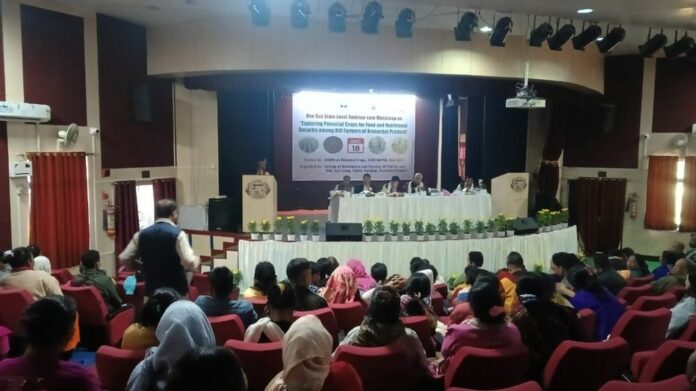
A significant shift toward buckwheat cultivation is transforming the agricultural landscape of Arunachal Pradesh, emerging as a vital strategy to bolster food and nutritional security for the state’s hill farmers. At a recent state-level seminar-cum-workshop held in Pasighat, agricultural experts highlighted the crop’s rapid expansion, noting that the area under buckwheat cultivation has grown from approximately 400 hectares to nearly 5,000 hectares. This surge reflects a growing acceptance among local farmers of the crop, known locally as phapar, which is increasingly recognized for its ability to withstand volatile climatic conditions while simultaneously enhancing rural incomes.
The program was organized by the College of Horticulture & Forestry (CHF), Pasighat, under the Central Agricultural University, Imphal, with critical support from the All India Coordinated Research Network (AICRN) on Potential Crops under ICAR–NBPGR, New Delhi. During the sessions, Dr. L. Wangchu, Dean of CHF, emphasized the urgency of diversifying the state’s agricultural output beyond traditional rice-centric farming. He pointed out that buckwheat is an ideal alternative for the region because it is protein-rich, requires no chemical fertilizers, and is particularly effective at addressing nutritional gaps among children. Scientists from ICAR–NBPGR further detailed its health benefits, noting its suitability for diabetic patients and its inherent resilience to climate change.
The workshop drew more than 200 farmers from across the districts of East Siang, Upper Siang, Siang, Lower Siang, and Lower Dibang Valley, as well as participants from the Dhemaji district of Assam. Beyond theoretical discussions, the event provided farmers with essential hands-on exposure through visits to experimental fields at CHF. A notable demonstration featured buckwheat cultivation integrated within oil palm plantations at the College of Agriculture, Pasighat, showcasing how diversified cropping systems can be successfully adapted to hill agriculture. These practical sessions were designed to equip attendees with the specific knowledge needed to manage buckwheat as a low-input, high-value crop.
Moving forward, the focus remains on sustaining this momentum through improved infrastructure and economic support. Dr. S. K. Yadav, Nodal Officer of AICRN on Potential Crops, observed that while buckwheat’s journey in the state has gained significant speed, the next steps must involve robust value addition and the establishment of better market linkages to maximize financial returns for farmers. By prioritizing crops that require minimal water and low input costs, officials and experts aim to create a more stable and self-sufficient agricultural model. The event concluded with a collective call for the wider adoption of such climate-resilient alternatives to ensure long-term food security and livelihood stability across the hill districts of Arunachal Pradesh.
