

Delhi: Central Board of Secondary Education has announced a major change in its curriculum structure by making the study of three languages compulsory for students of Classes 9 and 10 from the 2026-27 academic session, in line with the recommendations of National Education Policy 2020. The revised language policy will come into effect from July 1, 2026, with the aim of promoting multilingual learning and strengthening Indian languages in schools. Under the new structure, students will study three languages identified as R1, R2 and R3.
However, CBSE has clarified that there will be no board examination for the third language, known as R3, at the Class 10 level. The board stated that the decision was taken to encourage language learning without adding extra academic pressure on students preparing for board examinations. The move follows the recommendations of the National Curriculum Framework for School Education (NCF-SE) 2023, which strongly advocates multilingual education.
Also Read: PM Modi Praises India-Netherlands Friendship, Highlights Strong Diaspora Ties
To help schools during the transition period, CBSE has instructed institutions to temporarily use Class 6-level textbooks for the third language in Classes 9 and 10 until new textbooks are introduced. Schools have also been encouraged to use supplementary regional literature, poems and local stories to support learning. The board said detailed teaching guidelines would be issued before June 15, 2026.
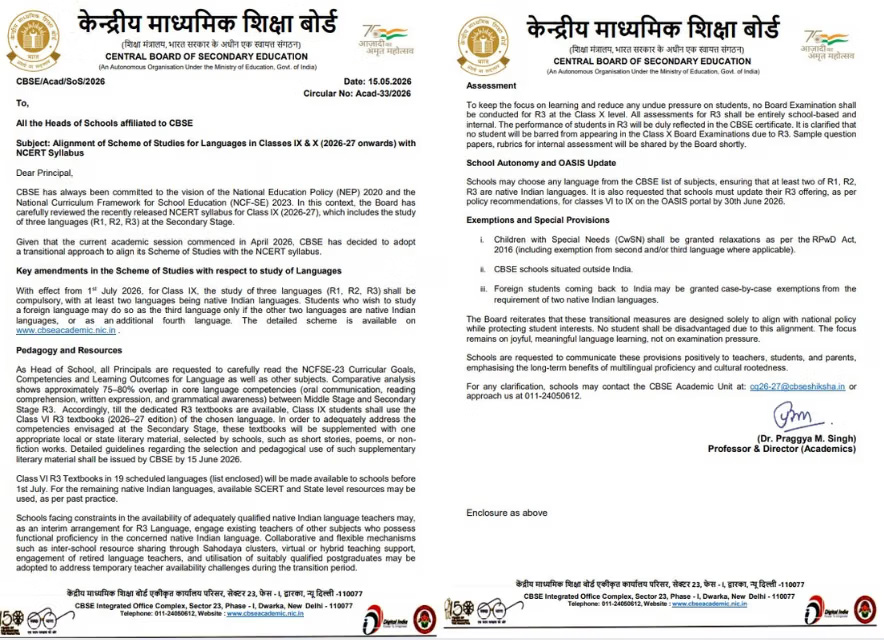
Addressing concerns regarding teacher shortages, especially in smaller schools, CBSE has allowed temporary measures such as sharing teachers through Sahodaya school clusters, hybrid and online teaching support, hiring retired language teachers and appointing qualified postgraduate instructors. CBSE also confirmed that textbooks for 19 scheduled Indian languages will be supplied to schools before July 1, 2026.
