
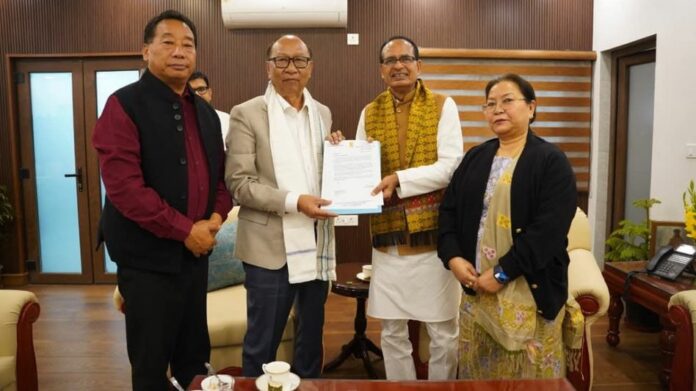
Imphal, Feb 24: Union Agriculture and Rural Development Minister Shivraj Singh Chouhan has approved the construction of 5,000 new homes for internally displaced persons in Manipur under the Pradhan Mantri Awaas Yojana – Gramin (PMAY–G), in a significant step towards rehabilitating families affected by the ongoing unrest in the state.
The decision followed a high-level meeting held in New Delhi on the evening of February 23 between Chouhan and a Manipur delegation led by Chief Minister Yumnam Khemchand Singh. The delegation also included Deputy Chief Ministers Nemcha Kipgen and Losii Dikho. During the discussions, the state leadership apprised the Union Minister of the prevailing ground situation, the scale of displacement and the pressing need for permanent housing for families living in relief camps and temporary shelters.
According to official sources, the 5,000 houses will be built under the Centre’s flagship rural housing scheme, which aims to provide pucca homes with essential amenities to eligible beneficiaries. The allocation has been specifically earmarked for families displaced during the prolonged ethnic violence that has affected Manipur since last year. The initiative is being viewed as part of the Centre’s broader efforts to restore stability in the northeastern state and facilitate dignified resettlement.
Earlier this month, the Manipur government had submitted a proposal seeking approval for a special PMAY–G project to construct 5,000 houses for those impacted by the violence. The Union Ministry of Rural Development has also approved a special window under the Awaass+ 2024 household survey to document eligible affected households. The state has been permitted to continue registering beneficiaries under the special project.
However, the Ministry has directed that beneficiaries must be identified strictly in accordance with PMAY–G guidelines and that details of eligible households be uploaded through the Awaass+ 2024 mobile application. The houses will be constructed as per the provisions of the scheme’s framework for implementation.
In addition, the state government has been allowed to sanction houses for beneficiaries who had earlier received one or more instalments under PMAY–G but whose homes were destroyed during the ethnic violence. The approvals are expected to pave the way for time-bound construction once beneficiary identification and verification are completed.
