
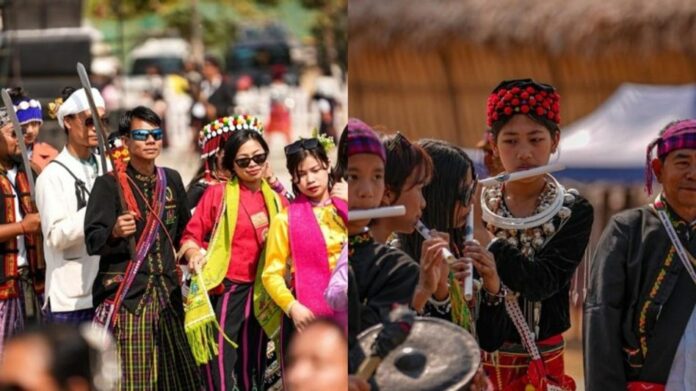
Itanagar, Feb 15: Chowna Mein joined the vibrant celebrations of Shapawng Yawng Manau Poi 2026 at Miao, urging communities to safeguard their indigenous culture, language and heritage amid the growing pressures of globalisation.
Addressing a large gathering, the Deputy Chief Minister said the festival goes beyond dance and celebration, emphasising its roots in sacred rituals that connect the Singpho community to its ancestral legacy. He underscored that such occasions should serve as platforms for reflection on societal responsibilities and the need to pass cultural values to future generations.
Highlighting the influence of modern education, fashion and external trends, Mein observed that while change is inevitable, communities must remain vigilant in preserving their distinct identity. “No one will come to preserve our culture; we must protect it ourselves,” he said, stressing that language is the strongest pillar of identity. He called for effective implementation of indigenous language education in schools, supported by dedicated teachers, to ensure preservation efforts are meaningful.
Referring to the vision of Narendra Modi on digitisation and heritage conservation, Mein spoke about efforts to document and digitise ancient manuscripts, oral traditions, folklore and archival records using modern technology. He said steps are being taken to digitise rare manuscripts and safeguard historical materials for future generations.
Earlier, Mein paid floral tributes at Martyr Hill to the unsung heroes of the Singpho community — Bom Singpho, Beesa Gaum, Ningru, Luttong Senapati, Duffa Gaum, Set Gaum and freedom fighter Luttora Gaum — acknowledging their sacrifices as enduring symbols of courage and resistance. He emphasised the importance of documenting local contributions, including the community’s role during the Second World War, to ensure rightful recognition in history.
During his visit, he toured the Tea and Textile Exhibition showcasing the rich cultural legacy of the Singpho people. He noted that the discovery of tea in India is closely linked to the Singpho tribe, recalling that in 1823, Robert Bruce received tea plants and seeds from Singpho Chief Beesa Gaum — a moment considered pivotal in the emergence of Assam Tea. The textile exhibition, organised by the Singpho Women’s Organisation in collaboration with researcher Dr Anna Louise Meynell, highlighted traditional weaving practices. Using back-strap looms, Singpho women produce vibrant handwoven textiles adorned with geometric motifs inspired by nature. Mein described weaving not merely as a craft but as a lifeline of society and a powerful expression of identity and resilience.
Expressing satisfaction at seeing young people proudly donning traditional attire, the Deputy Chief Minister urged the youth to actively participate in preserving their heritage, ensuring that the legacy of their forefathers continues to flourish.
