
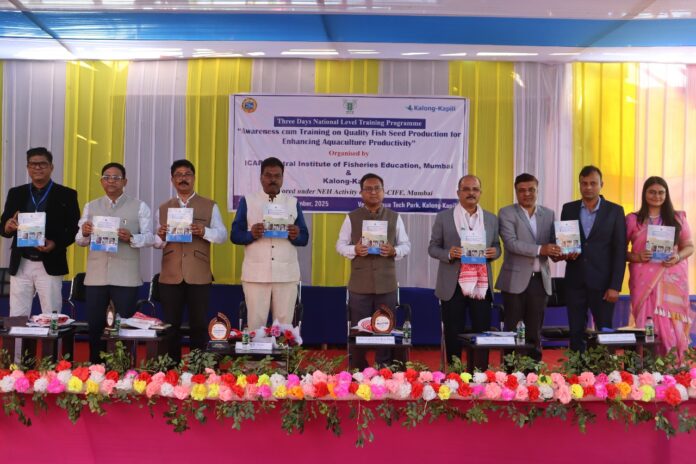
Nagaon: Chief Minister Dr Himanta Biswa Sarma today stressed on the importance and necessities of the aquaculture sector which recently has emerged as one of the most dynamic sectors contributing significantly to food security, livelihood generation and rural prosperity. Ensuring a steady supply of healthy, genetically robust and disease-free fish seed is central to sustaining this progress. Quality seed enhances productivity, strengthens ecological balance, reduces input costs and improves the long-term resilience of aquaculture systems.
Dr Sarma in a written message addressed fish farmers to build scientific awareness. He moreover urged to participate fish farmers in three days national level training cum awareness on “Quality Fish Seed Production for Enhancing Aquaculture Productivity”, Dr Sarma also asked fish farmers, researchers, practitioners and aspiring entrepreneurs to explore the scope, potential and methods for producing high quality fish seeds through scientific fish farming and adoption of modern fish farming technologies that will not only increase the yield but will also conserve the ecosystem and the environment. Over 200 participants from Assam and the other North Eastern states participated in the training programme. The training was jointly organized by ICAR-CIFE (Central Institute of Fisheries Education), Mumbai and Kalong-Kapili.
Also Read: Centre Announces New Weavers’ Service Centre for Meghalaya, Unveils Textile and Tourism Initiatives
Inaugurating the program, Dr N P Sahu, Director, ICAR-CIFE, Mumbai, said that CIFE will support Kalong-Kapili to move forward. He stated that quality fish seeds are scarce across the country. Species such as rohu, catla, and mrigal can attain up to 5 kg within one year by adopting various scientific techniques, including the development and use of improved varieties like Jayanti Rohu and Maha Magur. He highlighted that Andhra Pradesh has the highest fish production in India, while Assam ranks fourth. He stressed the need to focus on per capita fish consumption while simultaneously strengthening national fish production. He also emphasized the need for a long-term vision to strengthen fish production for the next 50 years. To increase farmers’ income, scientific fish farming practices must be adopted, including the use of quality fish seeds and intensive systems such as Biofloc and RAS. He further highlighted the importance of feed production and maintaining fish health. Dr Sahu also said that farmers who receive training at Kalong-Kapili will also receive financial support from the Bank of India.
Dr Debajit Sarma, Principal Scientist and Head, Division of Aquaculture, ICAR-CIFE, Mumbai, said that today’s inauguration of the training hall constructed at the Aqua Techno Park of Kalong-Kapili with the support of UJJIVAN SFB Bank will help provide training to farmers and other stakeholders. He highlighted that the soil quality of Assam is acidic and requires liming, unlike Andhra Pradesh, which has a more suitable environment for fish farming. He added that stunted fingerlings can be developed within three to four months under high stocking density, which can lead to better growth and improved fish production.
Director of Kalong-Kapili Jyotish Talukdar said that fish farming is one of the activities which is ecologically and environmentally acceptable in Assam. Referring to his experience in aquaculture, he said that aquaculture is a popular option for livelihoods because in many places agricultural or industrial activity are not feasible. The programme was attended by Loken Das, Chief General Manager, NABARD, Regional Office, Guwahati; Gauri Sankar Das, Director of Fisheries, Assam; Dr Pradip Chandra Bhuyan, Dean, college of Fisheries, Raha; and Chandan Buragohain, Cluster Head, Ujjivan Small Finance Bank. A bilingual handbook titled “Quality Fish Seed Production for Sustainable Aquaculture Growth” was also released during the programme. The programme concluded with the distribution of fishing nets, fish seeds and presentation of certificates to the farmers.
