
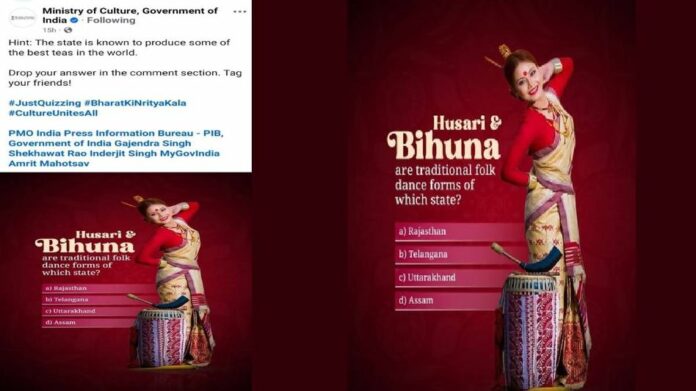
Guwahati, Feb 23: A quiz post by the Ministry of Culture has triggered a wave of criticism in Assam, after social media users flagged what they described as the misspelling and misrepresentation of two of the state’s most cherished traditions — Husori and Bihu.
The post, shared on the Ministry’s official Facebook account, offered a clue stating, “The state is known to produce some of the best teas in the world,” alongside an image of a young Assamese woman in traditional attire. It then posed the question: “Husari and Bihuna are traditional folk dance forms of which state?” While the intended answer was clearly Assam, many took issue with the spellings “Husari” and “Bihuna”, arguing that they reflected either carelessness or a lack of familiarity with the region’s cultural heritage.
The reaction was swift. Several users called out what they termed a disrespectful portrayal of Bihu culture. One comment questioned the term “Bihuna”, asserting that the correct references are “Bihu Nach” or “Bihu Naam”. Others echoed similar concerns and urged the Ministry to rectify what they believed was an avoidable mistake.
Among those who responded was noted filmmaker and critic Utpal Borpujari, who said that social media content issued by a Central Government ministry must be thoroughly vetted before publication. He remarked that such errors create unnecessary controversy and risk spreading misinformation. Borpujari added that despite multiple users highlighting the mistake in the comments section, the post had not yet been corrected.
At the centre of the debate are Husori and Bihu, both integral to Assam’s cultural identity. Husori, sometimes also spelled Huchori, is a traditional musical performance associated with Bohag Bihu. Typically performed by troupes of men during the spring festival, Husori involves visiting households, singing Bihu songs and offering blessings for prosperity in the coming year. Accompanied by instruments such as the dhol, pepa and taal, the performers are welcomed with offerings including gamocha and xorai filled with betel nuts.
Historically, Husori is believed to have origins tracing back to the Ahom era, when performances were held in royal courtyards such as Rang Ghar before evolving into a community-based tradition. Over time, it absorbed influences from Assam’s Neo-Vaishnavite movement led by the 15th–16th century reformer Srimanta Sankardev. His Ek Sarana Naam Dharma philosophy emphasised devotion and collective worship, reshaping Assam’s socio-cultural landscape and influencing performing arts traditions, including Ankiya Bhaona and the Sattriya dance form. While Sankardev did not directly reshape Bihu, elements of devotional expression gradually became visible in Husori performances.
Equally significant is Bihu, which many Assamese view not merely as a dance form but as a defining marker of identity. The state observes three major Bihu festivals — Rongali or Bohag Bihu celebrating spring, Kongali or Kati Bihu marking scarcity, and Bhogali or Magh Bihu as a harvest festival. Bihu Nach features energetic movements symbolising joy and fertility, with women wearing red-themed mekhela chador, often woven in muga silk and adorned with kopou flowers, and men dressed in dhoti and gamocha. Bihu Naam, lyrical and devotional songs, form an essential part of the festivities.
As of now, the Ministry has neither issued a clarification nor removed the post. However, the episode has reignited conversations around cultural sensitivity and the responsibility of national institutions to accurately represent India’s diverse traditions. For many in Assam, the issue transcended a typographical error, touching instead on questions of recognition, respect and the faithful portrayal of the state’s cultural heritage.
