
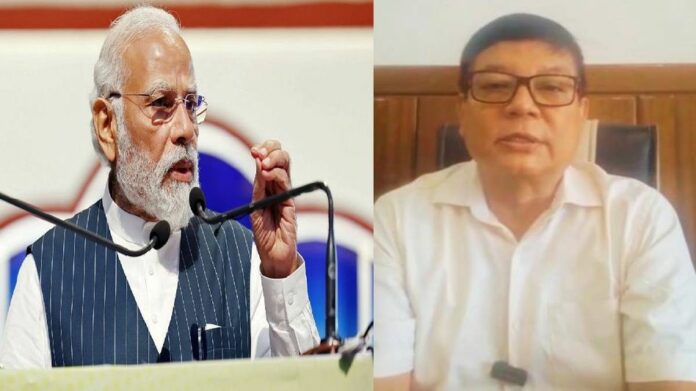
Senior Congress leader and former Leader of Opposition in the Assam Legislative Assembly Debabrata Saikia questioned the Narendra Modi government’s record on democracy, constitutional institutions, civil liberties, economic policy and governance as Prime Minister Narendra Modi marked 25 years as head of a government.
Modi entered his 25th year as head of a government in October 2025, having first taken oath as Gujarat Chief Minister in October 2001. In June 2026, he also became India’s longest-serving elected prime minister in terms of continuous tenure, according to official government records.
In a statement, Saikia said 25 years of public governance should be assessed not only through claims of achievements but also through the condition of democratic institutions, constitutional rights, civil liberties, economic security and the lives and livelihoods of ordinary citizens.
Saikia criticised what he described as a shrinking space for parliamentary scrutiny and cited the passage of major legislation without extensive committee examination or debate. He referred to the three farm laws enacted in 2020 and repealed in 2021 following prolonged farmers’ protests.
He also questioned the government’s handling of the 2019 changes relating to Jammu and Kashmir, including the abrogation of Article 370 and the reorganisation of the erstwhile state into two Union Territories. Saikia said major constitutional and political changes should be accompanied by greater transparency, consultation and protection of civil rights.
On civil liberties, he raised concerns over the use of stringent laws, investigations involving civil society organisations and allegations relating to surveillance. He referred to the Pegasus controversy and alleged restrictions affecting journalists, activists and government critics. He also questioned what he described as growing concerns over freedom of expression, including controversies surrounding films, documentaries and online content critical of the government.
On secularism and minority rights, Saikia cited the Citizenship Amendment Act, 2019, and controversies surrounding demolitions carried out against alleged offenders in some states. He also referred to concerns over hate speech and religious polarisation. The Supreme Court issued nationwide guidelines on demolitions in November 2024, stressing that authorities must follow due process before demolishing properties of accused persons.
Saikia questioned the government’s economic record, citing demonetisation, employment, inflation and the condition of small businesses and informal workers. He said the impact of economic policies should ultimately be assessed through household expenditure, employment opportunities and savings.
On digital payments, Saikia criticised the introduction of charges on certain high-value UPI merchant transactions. The new framework announced in September 2026 is an MDR applicable to specified person-to-merchant transactions above Rs 2,000, rather than a tax on UPI. Person-to-person transactions remain free, while the government has said around 96 per cent of merchant transactions will remain unaffected.
Saikia also questioned the independence of institutions such as the Enforcement Directorate, Central Bureau of Investigation and Income Tax Department, alleging that opposition leaders had faced disproportionate investigative action. He called for greater transparency and public confidence in the functioning of constitutional and electoral institutions.
The Congress leader referred to questions raised by opposition parties regarding electoral rolls, voting data, electronic voting machines, vote counting and political funding. He said such allegations should be examined through constitutional and institutional mechanisms.
On Manipur, Saikia said the prolonged ethnic violence had raised serious questions about governance and the government’s responsibility to protect life and property, rehabilitate displaced people and restore trust between communities.
He also criticised what he described as the growing concentration of economic resources and strategic assets among large corporate groups. Saikia called for greater transparency in public asset allocation, competitive processes and independent regulation. He referred to the Supreme Court’s 2024 judgment striking down the electoral bonds scheme and emphasising the importance of transparency in political funding.
On public infrastructure, Saikia questioned the condition of government schools, hospitals, roads and bridges and called for independent structural, safety and cost audits of major infrastructure projects.
Turning to Assam-specific issues, Saikia raised the pending NRC process, floods and river erosion and the long-standing demand for Scheduled Tribe status for six communities — Moran, Matak, Chutia, Tai-Ahom, Koch-Rajbongshi and Tea Tribes.
He said the Final NRC was published on August 31, 2019, with 19,06,657 people excluded, according to official NRC data, and questioned the delay in completing the subsequent process.
On Assam’s recurring floods, Saikia called for a shift from temporary relief to long-term rehabilitation. Referring to the severe flooding in July 2026, he demanded a special rehabilitation and reconstruction package for affected families, including compensation for losses to homes, agricultural land, livelihoods, livestock and other assets.
Saikia also criticised the government’s record on employment, price rise and the fulfilment of electoral promises made in 2014. He questioned the status of commitments relating to black money, job creation, farmers’ incomes and inflation.
India’s retail inflation rose to 4.82 per cent in August 2026 from 4.45 per cent in July, while food inflation stood at 5.95 per cent, according to official data.
On foreign policy, Saikia alleged that India’s diplomatic influence and strategic interests had suffered under the Modi government. He also raised concerns over India’s trade deficit with China and relations with neighbouring countries. Saikia further questioned the Prime Minister’s engagement with the media, alleging that Modi had avoided regular open press conferences and relied largely on speeches and selected interviews.
Concluding his statement, Saikia said the 25-year milestone should be viewed as a period of accountability and questioned whether democracy, civil liberties, institutional independence, economic security and the welfare of ordinary citizens had strengthened during Modi’s years in power.
“25 years in power means a time of accountability for 25 years,” Saikia said.
He also invoked former Prime Minister Atal Bihari Vajpayee’s 2002 remarks on ‘Rajdharma’ while criticising what he described as increasing religious and social polarisation.
Saikia alleged that the Modi government had prioritised political power and the interests of large corporate groups over broader public welfare. He said democratic institutions, constitutional values and social harmony should remain central to governance.
