
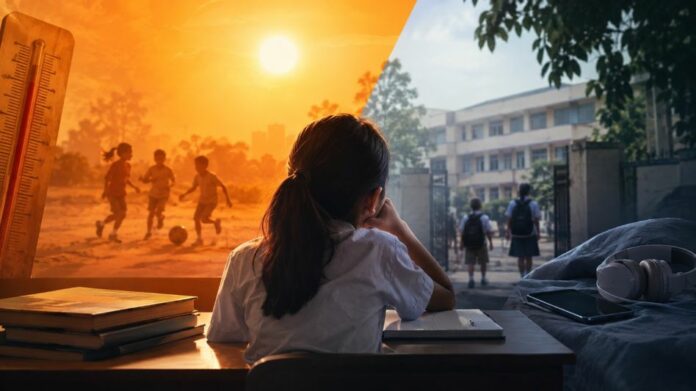
GUWAHATI, September 10: Extreme temperatures can reduce the time children spend on learning while increasing leisure activities, according to a study by IIT Guwahati researcher Prof Bhaskar Jyoti Neog.
Published in Review of Economics of the Household, a Springer Nature journal, the study analysed data from India’s nationally representative Time Use Survey 2019 along with daily weather information.
The findings showed that children tended to spend less time learning and more time on leisure when temperatures reached extreme levels. School and college attendance also declined on hotter days, suggesting that extreme weather could disrupt education beyond its direct impact on academic outcomes.
Prof Neog, Assistant Professor in the Department of Humanities and Social Sciences at IIT Guwahati, said the study highlighted children’s time allocation as another way in which weather could affect well-being and human capital formation.
“Most of the evidence from developing countries has focused on indirect effects of weather, particularly through agricultural productivity and household agricultural incomes,” Neog said. “By focusing on children’s daily activities, the study draws attention to an additional dimension of the economic and welfare costs associated with extreme weather.”
The research also found evidence of long-term acclimatisation. The relationship between temperature and children’s use of time was weaker in areas that typically experienced warmer climates, suggesting that people could adjust their behaviour to climatic conditions they regularly encountered.
However, the study found no conclusive evidence that people similarly adapted to unpleasant weather conditions over shorter periods.
The impact of extreme temperatures also varied across socio-economic groups. The relationship between temperature and time use was weaker among boys and children from more educated and relatively better-off households, indicating that household resources and socio-economic conditions could influence children’s ability to cope with extreme weather.
The researchers also examined how climate change could affect children’s allocation of time towards the end of the century. Using climate projections, the study assessed potential changes in learning and leisure under a future climate scenario, assuming no additional adaptation.
The findings highlighted the need for education systems to become more resilient to climate-related disruptions. Measures could include strengthening school infrastructure, ensuring continuity of learning during extreme weather, considering flexible school hours and academic calendars, and expanding blended or digital learning where feasible.
The study cautioned that adaptation measures should not deepen existing inequalities, as children with limited access to cooling facilities, protective infrastructure or digital technology could face greater disruption during extreme weather.
The research has implications for education policy, climate adaptation, school infrastructure planning and efforts to address educational inequalities. It also called for further research into the effects of weather on children’s sleep, physical activity, health, cognitive and non-cognitive development and social interaction.
Prof Neog plans to further examine how children, households and educational institutions adapt to extreme weather and assess the effectiveness of measures such as climate-resilient schools, flexible academic schedules and alternative modes of learning.
