
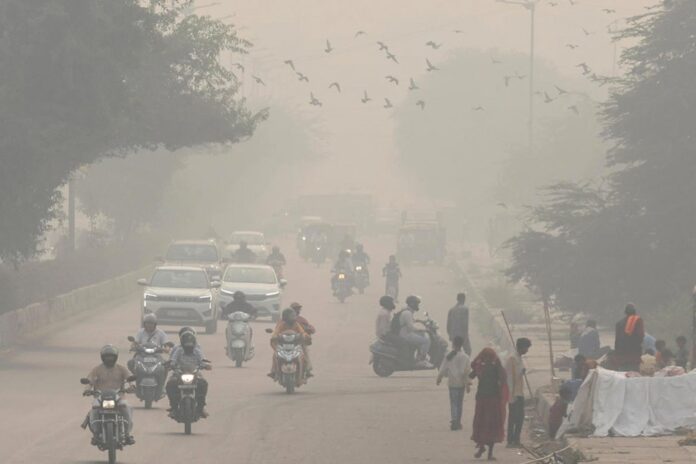
An important high-level meeting chaired by Chief Secretary Dr Ravi Kota, IAS, was held to review air pollution levels in Guwahati and its adjoining areas and to assess measures for improving air quality. Senior officials from Guwahati Municipal Corporation (GMC), Pollution Control Board Assam, Urban Development, Industries and Commerce, Forest (Roads), and other relevant departments attended the discussion.
The Chief Secretary highlighted that the dry winter season is likely to increase suspended particulate matter, urging all concerned departments to intensify both preventive and corrective actions to curb air pollution.
According to a recent study under the National Clean Air Programme (NCAP), the major sources of pollution in Guwahati include dust from roads and construction sites, vehicular emissions, industrial fumes, and garbage burning, all contributing to rising levels of PM10 and PM2.5. The city’s bowl-shaped topography, surrounded by about 32 small hills, along with dust carried from the dry Brahmaputra riverbed, further aggravates the situation.
To address this, GMC has already deployed six water-sprinkling vehicles and four mechanical road sweepers to reduce road dust, while four additional sweeping machines are in the process of procurement. Parallel initiatives include extensive drainage, road construction, and maintenance to prevent dust generation. The Forest (Roads) Department has also begun water sprinkling and regular monitoring of dust at designated sensitive points across the city.
A major step towards long-term control is the enhancement of public transport. Assam State Transport Corporation has started operating electric buses under Smart Mission, while plans for procuring 100 CNG buses for Guwahati are under way. GMC has acquired 180 vehicles to strengthen waste collection and reduce garbage burning, a key contributor to air pollution. The state government has also encouraged the implementation of the Assam Vehicle Scrappage Policy, 2022, along with tax exemptions to promote electric vehicles.
Additionally, GMC has planned the plantation of trees in 20 public parks and open spaces to improve greenery and support long-term air quality enhancement.
The Pollution Control Board Assam is currently monitoring air quality across 10 manual and four continuous monitoring stations. Real-time data is regularly submitted to the Central Pollution Control Board for daily Air Quality Index updates. The Board has also partnered with the International Forum for Environment, Sustainability & Technology (iFOREST) for a detailed scientific assessment of Guwahati’s air quality.
Recent measures have shown progress, with annual PM levels declining from 119 μg/m³ in 2023–24 to 103 μg/m³ in 2024–25. This improvement helped Guwahati rise from rank 38 to 21 in the Swachh Vayu Survekshan 2025.
Authorities noted that sustained departmental coordination, continuous scientific assessment, and planned city expansion will be crucial in ensuring cleaner air and a healthier living environment for Guwahati’s residents in the coming years.
