
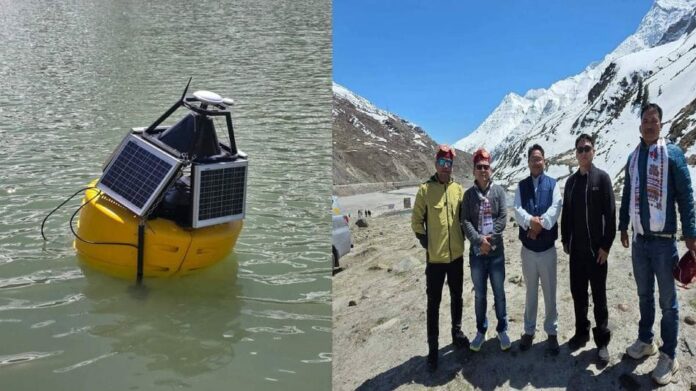
In a significant stride toward bolstering disaster resilience in the high-altitude Himalayan belt, the Centre for Development of Advanced Computing (C-DAC) has successfully deployed a proof-of-concept Glacial Lake Outburst Flood (GLOF) early warning system at Sissu Lake in Himachal Pradesh. Developed in close collaboration with the National Disaster Management Authority (NDMA), this indigenous technological intervention is designed to monitor glacial dynamics and provide critical alerts to downstream communities. The initiative addresses a growing vulnerability in the region, where the intensification of glacier melt has heightened the threat of sudden, catastrophic floods that jeopardize both human lives and vital infrastructure.
To evaluate the system’s real-world efficacy, NDMA Secretary Manish Bhardwaj recently led a high-level delegation to the Sissu Lake site. The visit focused on a comprehensive review of the system’s architecture and its operational performance under field conditions. Beyond mere assessment, the delegation explored strategies for scaling this technological solution to other high-risk glacial lakes across the Indian Himalayan region, emphasizing the urgency of creating a wider safety net as climate change continues to accelerate glacier retreat and alter mountain ecosystems.
The deployment comes at a critical juncture as rising global temperatures transform glacial landscapes, making GLOF events increasingly probable. Recognizing these environmental shifts, officials and technical experts engaged in detailed sessions to address the practicalities of long-term implementation. Key discussions centered on the sustainability of the equipment in harsh climates, the precision of real-time data monitoring, and the logistical challenge of disseminating life-saving alerts to remote, at-risk populations.
Ensuring the system’s ultimate success depends on more than just technical accuracy; it requires a robust framework for communication and community integration. During the site review, authorities highlighted the necessity of establishing reliable data channels and involving local residents in the warning framework to guarantee a swift and organized response during emergencies. As field assessments continue, the performance of this C-DAC developed system at Sissu Lake will serve as the benchmark for a potential regional expansion, aiming to significantly reduce disaster risk across India’s most vulnerable mountain corridors.
