
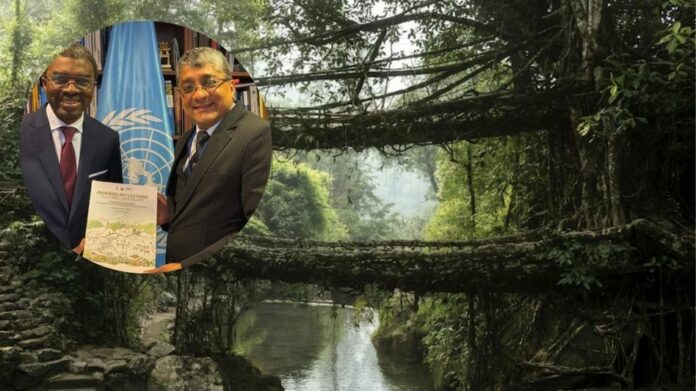
Shillong, Jan 29: India has formally submitted the nomination dossier for the Jingkieng Jri / Lyu Chrai cultural landscape of Meghalaya to UNESCO, marking a major step towards global recognition of Indigenous heritage from the Northeast. The submission places the site in contention for inscription on the UNESCO World Heritage List during the 2026–27 evaluation cycle.
The nomination dossier was handed over in Paris by India’s Ambassador and Permanent Representative to UNESCO, Vishal V Sharma, to Lazare Assomo Eloundou, Director of UNESCO’s World Heritage Centre. Confirming the development, Meghalaya Chief Minister Conrad K Sangma said the Living Root Bridges dossier had been officially lodged for consideration, describing it as a moment of pride for the state and its people. He noted that the submission comes soon after Padma Award recognition was conferred on Bah Halley War for his lifelong contribution to preserving and promoting the Living Root Bridges tradition.
The proposed World Heritage site covers parts of the Khasi and Jaiñtia Hills and represents a living cultural landscape shaped by generations of Khasi and Jaintia communities. Unlike monument-based heritage sites, Jingkieng Jri / Lyu Chrai reflects an ongoing relationship between people and nature, where traditional governance systems, land-use practices and ecological knowledge remain active elements of daily life. Central to this landscape is an Indigenous philosophy grounded in reverence for Mei Ramew, or Mother Earth, which guides sustainable resource use and conservation.
While submitting the dossier, Ambassador Sharma acknowledged the collective efforts behind the nomination, including contributions from Prime Minister Narendra Modi, Union Culture Minister Gajendra Singh Shekhawat, Chief Minister Conrad Sangma, Principal Secretary Frederick Kharkongor, officials from the Archaeological Survey of India and the Ministry of External Affairs, as well as experts and local communities who have safeguarded the heritage over centuries.
The nomination is being viewed as a significant shift in India’s heritage representation at UNESCO, highlighting living, community-led cultural landscapes from Indigenous regions rather than focusing solely on architectural monuments. If approved, Jingkieng Jri / Lyu Chrai would become one of the few cultural landscapes from India to receive UNESCO recognition, drawing global attention to Meghalaya’s unique tradition of sustainable coexistence between humans, nature and belief systems.
Expressing hope ahead of the evaluation process, the Chief Minister said inscription would ensure that the Indigenous communities who have nurtured the Living Root Bridges for generations receive the international recognition they deserve as custodians of this extraordinary living heritage.
