
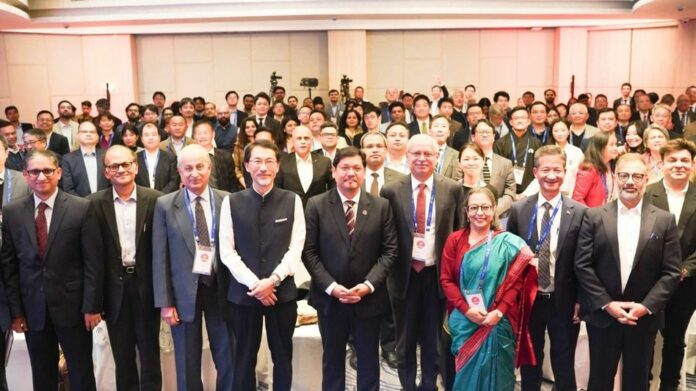
Shillong, Feb 27: The sixth edition of the India–Japan Intellectual Conclave, “KIZUNA-6: Scaling up Partnerships”, commenced on February 26 in Meghalaya, focusing on expanding bilateral cooperation across strategic sectors.
The two-day conclave is being organised by Asian Confluence in collaboration with the Ministry of External Affairs, the Embassy of Japan in India, the Meghalaya Basin Development Authority (MBDA) and the Sasakawa Peace Foundation. In his welcome address, Asian Confluence Executive Director Sabyasachi Dutta underlined Assam’s infrastructure push aimed at accelerating development in the state and the wider Northeast.
Delivering the inaugural address, Conrad K. Sangma highlighted the growing momentum of the India–Japan partnership, particularly in infrastructure, healthcare, agriculture, culture and human resource mobility between the Northeast and Japan. He outlined Meghalaya’s ambition to emerge as India’s football hub and a vibrant music and cultural centre, while emphasising the potential for exporting high-value agricultural products such as bamboo. He also detailed ten governance commitments focused on connectivity and infrastructure.
Sangma described Japan as a trusted development partner, citing initiatives ranging from youth empowerment to clean energy and infrastructure. He noted that 47 nurses from Meghalaya have been placed in Japan and that over 500 youth are expected to be trained and placed this year, with plans to scale up to 5,000 over five years. He also referred to India’s first commercial Shiitake block production in Upper Shillong, benefiting more than 1,000 farmers, and highlighted cultural exchanges such as the Japanese Pavilion at the Shillong Cherry Blossom Festival.
With 74 per cent of Meghalaya’s population under 35, the Chief Minister proposed the creation of a Meghalaya–Japan Skill Corridor to combine Japan’s technological expertise with the state’s youthful workforce. He expressed hope that the initiative would strengthen long-term collaboration and shared growth.
Japan’s Ambassador to India, Ono Keiichi, emphasised the strategic importance of Northeast India and said shared democratic values make India and Japan natural partners in promoting a free and open Indo-Pacific. He referred to Japan’s ongoing projects in the Bay of Bengal region and underscored opportunities to enhance connectivity and sustainable development.
Senior officials including Sampath Kumar, Principal Secretary to the Government of Meghalaya, highlighted the state’s investments in artificial intelligence and the need to strengthen both technical and soft skills. N.J. Gangte of the MEA pointed to potential collaboration in areas such as critical minerals, semiconductors and clean energy.
Earlier in the day, a Japanese delegation visited the Tata Group semiconductor plant site at Jagiroad in Assam. Representatives from key Japanese development partners, including Japan Bank for International Cooperation (JBIC), Japan External Trade Organization (JETRO) and Japan International Cooperation Agency (JICA), are participating in the conclave.
Discussions during the event will centre on three core themes: the semiconductor ecosystem, circular economy and clean energy, and talent mobility, as both nations seek to scale up strategic cooperation.
