
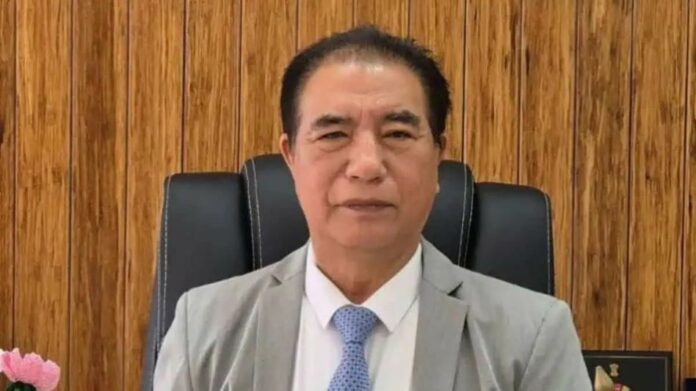
Aizawl, Feb 28: Amid intense debate on social media and public forums, Lalduhoma has defended the recent amendments to the Mizo marriage and inheritance law, asserting that the changes were not a unilateral decision but the outcome of a broad consultative process.
The Mizo Marriage and Inheritance of Property (Amendment) Bill, introduced by Lalduhoma in his capacity as Law Minister, was passed by the Mizoram Legislative Assembly earlier this month. The legislation further codifies Mizo customary law and strengthens the principal Act of 2014 by incorporating provisions related to polygamy, inter-community marriages and women’s property rights.
Under the amendment, polygamy is formally banned and women are granted the right to claim up to 50 per cent of matrimonial property. However, controversy has erupted over interpretations suggesting that Mizo women who marry non-Mizo men could lose their Mizo identity and Scheduled Tribe (ST) status. The issue has drawn sharp criticism from civil society groups, particularly the Mizo Hmeichhe Insuihkhawm Pawl (MHIP), which has urged the state government to withdraw the Bill, calling it potentially unsafe for Mizo women.
Responding to the criticism during a discussion on a private member’s resolution in the Assembly, Lalduhoma stated that the Bill was based on recommendations of the Mizo Customary Law Review Committee. He noted that the panel comprises representatives from 10 organisations, including MHIP and the Central Young Mizo Association (CYMA), along with experts from Mizoram University and the state law college.
The Chief Minister explained that the earlier Mizo Marriage, Divorce and Inheritance of Property Act, 2014 stipulated that a Mizo woman marrying outside the community was deemed to have entered her husband’s family, thereby separating her from Mizo customary rights. “Our customary law does not clearly explain the status of Mizo women who marry outside the community; instead, it simply rejects them,” he said, adding that the law is also silent on the status of children raised strictly in accordance with Mizo culture and traditions.
Citing a May 1977 circular issued by the Ministry of Home Affairs, Lalduhoma noted that a Tribal Certificate may be granted to children of inter-caste or inter-tribe marriages if they are brought up as tribals, face similar social disadvantages and are accepted by the community. However, he emphasised that such cases must be assessed individually and cannot be treated as a blanket rule. He also referred to a similar circular issued in October 2019 by the Ministry of Social Justice and Empowerment concerning children of divorced women.
The Chief Minister further clarified that a Supreme Court ruling delivered in November last year applied specifically to the individual petitioner and did not constitute a general judgment applicable to all Scheduled Castes or Scheduled Tribes. Observing that inter-community marriages are inevitable in today’s “global village”, Lalduhoma urged the public to move away from what he termed an “insular mentality”. He added that he personally knows several Mizo women married to non-Mizos who continue to be respected and actively contribute to Mizo society.
Acknowledging the sensitivity and complexity of the issue, Lalduhoma suggested that a separate committee could be constituted to examine more comprehensively the legal and social status of Mizo women who marry outside the community and that of their children, signalling the government’s openness to further review and dialogue.
