
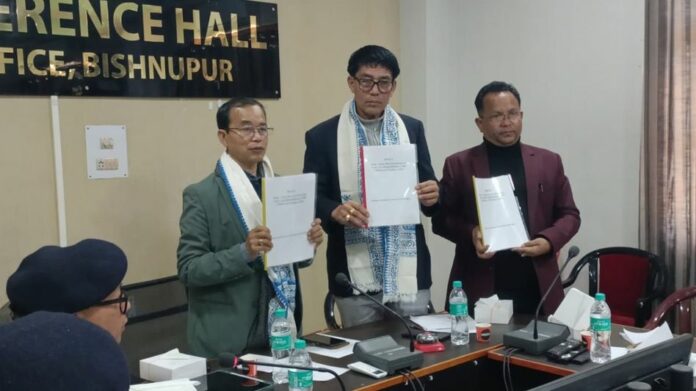
Imphal, Jan 3: The Manipur Commission for Protection of Child Rights (MCPCR) has placed a Draft State Action Plan aimed at the protection and rehabilitation of children displaced by the ongoing violence in the state, highlighting the pressing need for coordinated, child-focused interventions to address the prolonged humanitarian impact.
The draft was presented at a Stakeholders’ Convergence and Review Meeting held at the Deputy Commissioner’s office in Bishnupur district, chaired by MCPCR Chairperson Keisam Pradipkumar. The meeting brought together officials and stakeholders to assess current welfare, protection and rehabilitation measures for internally displaced children and to gather suggestions for strengthening a rights-based response.
Stressing the seriousness of the situation, Pradipkumar called upon the state government to announce a State Transitional Support Plan for internally displaced persons undergoing resettlement. He also pressed for the early notification of the Manipur State Policy for Children, saying these steps would substantially improve the state’s capacity to respond to the long-term needs of displaced children.
Sharing district-level updates, Additional District Magistrate T. Opendro said that 292 households, comprising 1,027 people, have been resettled in Bishnupur district so far. He added that housing assistance is being provided under the Pradhan Mantri Awas Yojana, with Rs 70,000 sanctioned for partially damaged houses and Rs 3 lakh for fully damaged ones. Out of 1,180 applications received, 40 houses have already been constructed.
District Child Protection Officer Indrani Devi informed the meeting that 1,862 children have been recommended for benefits under the Mission Vatsalya Sponsorship Scheme, while 2,798 displaced children in the district have been identified as Children in Need of Care and Protection.
Participants, however, expressed serious concern over the limited reach and rigid structure of Mission Vatsalya in the context of Manipur’s conflict situation. The meeting underlined the need for greater flexibility in policy implementation, consistent follow-up mechanisms, and stronger mental health and psychosocial support through effective coordination among health services, District Child Protection Units, juvenile justice institutions and community-based systems.
The discussions concluded with a unified call for a more adaptive, responsive and comprehensive framework to ensure the protection, rehabilitation and overall well-being of internally displaced children across Manipur.
