
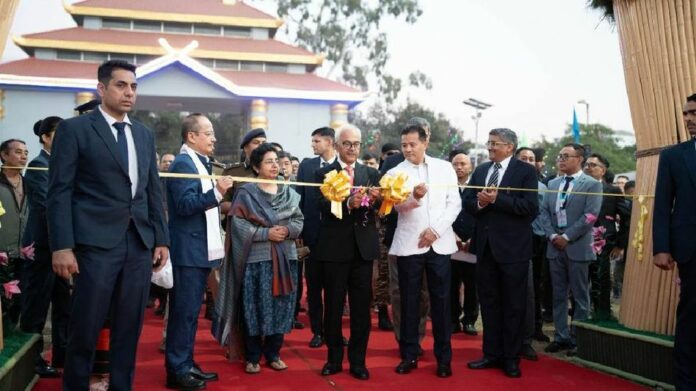
The twelfth edition of the Manipur Sangai Festival began on 21 November at Hapta Kangjeibung, Imphal, under an unusually tense backdrop marked by protests, widespread boycotts and tight security. Governor Ajay Kumar Bhalla formally inaugurated the event, which returned this year after a two-year break.
Multiple civil organisations, including internally displaced families and the Coordinating Committee on Manipur Integrity (COCOMI), strongly objected to holding the festival at a time when thousands continue to remain in relief camps. Demonstrators argued that celebrating a cultural event while the state struggles to restore normalcy was inappropriate, leading to what officials described as one of the lowest inaugural turnouts in the festival’s history.
Despite the resistance, Governor Bhalla and the First Lady toured the festival grounds before addressing attendees at the Bhagyachandra Open Air Theatre. In his remarks, the Governor said the Sangai Festival remains a symbolic showcase of Manipur’s cultural richness, tourism sector and entrepreneurial talent. He described Manipur’s heritage as a national treasure and said the festival’s multi-venue layout reflects the state’s resilience and determination to rebuild its economy.
Calling the festival a “Festival of Oneness,” the Governor emphasised unity between hill and valley communities through shared cultural narratives. He highlighted Manipur’s recognition as the birthplace of modern polo, locally known as Sagol Kangjei, and reiterated efforts to protect the endangered Manipuri Pony. He also confirmed that more than 135 tourist sites across the state are being identified for integrated development.
Acknowledging the humanitarian crisis, the Governor assured that the government is prioritising the welfare of displaced residents through phased resettlement, financial aid, prefabricated shelters and cash-support schemes aimed at restoring stability and dignity.
The inauguration was attended by MLAs Biswajit Singh and Basanta Kumar, along with senior bureaucrats, security advisors and members of the public. This year’s festival features cultural showcases, indigenous sports, literary events, film screenings, traditional boat racing, tourism familiarisation tours and the Cherry Blossom Festival at Mao.
