
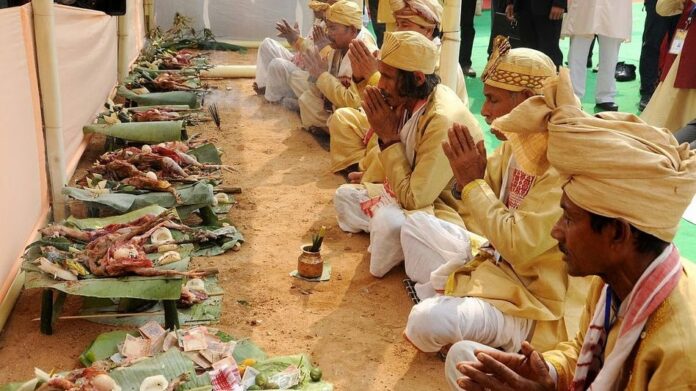
Guwahati, Jan 31: January 31 is marked with deep spiritual significance by the Tai Ahom community of Assam as Me-Dam-Me-Phi, an ancestral festival dedicated to remembering and venerating forefathers. Observed with prayers and rituals, the day reflects the community’s enduring belief that ancestors continue to protect, guide and bless the living, ensuring peace, prosperity and well-being.
The festival’s name itself embodies its philosophy. In the Tai Ahom tradition, “Me” signifies offerings or libations, “Dam” refers to the souls of deceased ancestors, and “Phi” represents the supreme ancestral or divine spirits. Together, Me-Dam-Me-Phi symbolises the idea that the living remain spiritually connected to their ancestors, who act as intermediaries between human beings and the divine.
Community participation lies at the heart of the observance. Villagers collectively erect an eight-sided temporary shrine known as Ho-Phi, or Deushal, where eight ceremonial trays are placed and offerings are made to revered ancestral spirits, including the primordial ancestor Lengdon. The hoisting of the Ngai-Ngao-Kham, a flag bearing the golden dragon, forms a key ritual, symbolising authority, continuity and divine protection. The ceremonies culminate in a community feast, reinforcing bonds of unity and shared identity. Traditionally, the first public observance of Me-Dam-Me-Phi is believed to have taken place at Budha Dangoria Than in Tipam.
Alongside public ceremonies, the festival is also observed within households. Domestic rituals are performed near the southern pillar of the kitchen, known as Pho-Kam, where offerings are made and prayers recited to invoke ancestral blessings. According to Tai Ahom belief, ancestors transform into Dam-Phi after death and reside in one of seven heavenly realms. The community does not subscribe to the idea of rebirth; instead, ancestors are believed to remain guardians of their descendants across generations.
Ritual offerings typically include cooked rice with fish and meat, sweet dishes such as payas, local delicacies and traditional rice beer. Through these offerings, families seek Janming, or ancestral blessings, while prayers are conveyed to higher deities through the spirits of forefathers. In some traditional practices, poultry sacrifice accompanied by mantras is also performed, reflecting ancient folk customs that continue to survive in parts of the community.
Ancestral spirits are classified into different categories, including principal household ancestors, those from earlier generations, recently deceased family members, and spirits of those who died young or without descendants. Except for certain categories, most are collectively regarded as household ancestors and are worshipped during the festival along with revered entities such as Lengdon and other divine spirits central to Tai Ahom cosmology. The rituals are conducted by traditional priests—Mohan, Deodhai and Bailung—who recite mantras from ancient Tai manuscripts, preserving centuries-old spiritual knowledge.
Historically, Me-Dam-Me-Phi is closely linked to the origins of the Ahom kingdom. Accounts suggest that Chaolung Sukaphaa, the founder of the Ahom dynasty, observed the ritual during his journey to Assam, and subsequent Ahom kings continued the tradition before establishing capitals such as Charaideo. Mythological narratives trace the festival’s origin to a divine command from heavenly beings, further reinforcing its sacred status.
Despite cultural and religious changes over centuries, including the spread of Buddhism among Tai groups elsewhere, the practice of ancestor worship has remained central to Tai Ahom identity. Me-Dam-Me-Phi continues to stand as a living tradition, reaffirming the belief that the past, present and future are inseparably linked through ancestral wisdom, cultural continuity and spiritual faith.
